DEF 14A: Definitive proxy statements
Published on April 23, 2026
UNITED STATES
SECURITIES AND EXCHANGE COMMISSION
Washington, D.C. 20549
Proxy Statement Pursuant to Section 14(a) of the Securities
Exchange Act of 1934 (Amendment No. )
Filed by the Registrant ☒
Filed by a party other than the Registrant ☐
Check the appropriate box:
| ☐ | Preliminary Proxy Statement |
| ☐ | Confidential, for Use of the Commission Only (as permitted by Rule 14a-6(e)(2)) |
| ☒ | Definitive Proxy Statement |
| ☐ | Definitive Additional Materials |
| ☐ | Soliciting Material under §240.14a-12 |
| (Name of Registrant as Specified In Its Charter) |
| (Name of Person(s) Filing Proxy Statement, if other than the Registrant) |
Payment of Filing Fee (Check all boxes that apply):
| ☒ | No fee required |
| ☐ | Fee paid previously with preliminary materials |
| ☐ | Fee computed on table in exhibit required by Item 25(b) per Exchange Act Rules 14a-6(i)(1) and 0-11 |

ANNUAL MEETING AND PROXY STATEMENT
Annual Meeting To Be Held June 10, 2026
To the Stockholders of Chimera Investment Corporation:
It is my pleasure to invite you to attend the 2026 annual meeting of stockholders (the “Annual Meeting”) of Chimera Investment Corporation, a Maryland corporation (“Chimera” or “the Company”), that will be held on June 10, 2026, at 10:00 a.m., Eastern Time.
This year’s Annual Meeting will once again be a virtual meeting held over the Internet. We believe that the use of the Internet to host the Annual Meeting enables expanded stockholder participation. You will be able to attend the Annual Meeting, vote your shares electronically and submit your questions during the live webcast of the meeting by visiting www.virtualshareholdermeeting.com/CIM2026 and entering your 16-digit control number.
The accompanying Notice of the Annual Meeting and Proxy Statement tells you more about the agenda and procedures for the meeting. They also describe, among other things, how the Company’s Board of Directors operates and provide information about our director candidates, executive officer and director compensation and corporate governance. I look forward to sharing more information with you about Chimera at the Annual Meeting.
Your vote is very important. Whether or not you plan to virtually attend the Annual Meeting, I urge you to authorize your proxy as soon as possible. You may authorize your proxy on the Internet, by telephone, or by mail. Your vote will ensure your representation at the Annual Meeting regardless of whether you attend via webcast on June 10, 2026.
Sincerely,
Phillip J. Kardis II
President and Chief Executive Officer
April 23, 2026
NOTICE OF ANNUAL MEETING OF STOCKHOLDERS OF CHIMERA INVESTMENT CORPORATION
| Time: | 10:00 a.m. Eastern Time | |
| Date: | Wednesday, June 10, 2026 | |
| Place: | Virtual meeting via webcast at www.virtualshareholdermeeting.com/CIM2026 | |
| Purpose: | This year’s Annual Meeting will be held for the following purposes: | |
| ● | To elect three Class I Directors, Kevin G. Chavers, Gerard Creagh and Susan Mills, each to serve until our annual meeting of stockholders in 2029 and until their successors are duly elected and qualify; | |
| ● | To consider and vote upon a non-binding advisory resolution to approve our executive compensation; | |
| ● | To consider and vote upon the ratification of the appointment of Ernst & Young LLP as our independent registered public accounting firm for 2026; and | |
| ● | To transact such other business as may properly come before the Annual Meeting or any adjournment or postponement thereof. | |
| Other Important Information: |
● | We utilize the “notice and access” model rather than mailing full sets of proxy materials to stockholders, as we think, among other things, the Company benefits from the reduced costs associated with this method of delivery. Thus, on or about April 23, 2026, we expect to commence mailing of a Notice of Internet Availability of Proxy Materials, which contains information regarding electronic access to our proxy materials and voting information. However, we will mail hard copies of the proxy materials to any stockholder who requests them. Our Proxy Statement and 2025 Annual Report are available at www.proxyvote.com. |
| ● | Record holders of our common stock at the close of business on April 9, 2026, may attend and vote at the Annual Meeting and any adjournments or postponements thereof. | |
| ● | Your shares cannot be voted unless they are represented by proxy or in person by the record holder attending the Annual Meeting via webcast. Whether or not you plan to attend the Annual Meeting via webcast, please vote your shares by proxy to ensure they are represented at the Annual Meeting. | |
By order of the Board of Directors,
Miyun Sung
Chief Legal Officer and Corporate Secretary
| Important
Notice Regarding the Availability of Proxy Materials for the Stockholder Meeting to Be Held June 10, 2026. Our Proxy Statement and 2025 Annual Report to Stockholders are available at www.proxyvote.com. |
| TABLE OF CONTENTS |
This page intentionally left blank

ONE ROCKEFELLER PLAZA, 32nd FLOOR
NEW
YORK, NEW YORK 10020
2026 ANNUAL MEETING OF STOCKHOLDERS
PROXY STATEMENT
| INFORMATION ABOUT THE MEETING |
General Information
These materials are intended to solicit proxies on behalf of the Board of Directors (the “Board of Directors” or the “Board”) of Chimera Investment Corporation, a Maryland corporation (which we refer to as “Chimera,” the “Company,” “we,” or “us”), for the 2026 Annual Meeting of Stockholders (“Annual Meeting”), including any adjournment or postponement thereof. This year, the Annual Meeting will once again be a virtual meeting of stockholders. This means you will be able to attend the Annual Meeting, vote and submit questions during the Annual Meeting via a live webcast by visiting www.virtualshareholdermeeting.com/CIM2026. The meeting will convene at 10:00 a.m. Eastern Time on June 10, 2026.
Items to be Voted on at the Annual Meeting
| (1) | Election of three Class I Directors, Kevin G. Chavers, Gerard Creagh and Susan Mills, each to serve until our annual meeting of stockholders in 2029 and until their successors are duly elected and qualify; | |
| (2) | Consider and vote upon a non-binding advisory resolution to approve our executive compensation; and | |
| (3) | Ratification of the appointment of Ernst & Young LLP (“Ernst & Young”) as our independent registered public accounting firm for 2026. |
Other than these three items, we know of no other business to be considered at the Annual Meeting. If any other business is properly presented at the Annual Meeting, your signed proxy card authorizes your proxy to vote on those matters at his or her discretion.
Board of Directors Recommendation
Our Board of Directors recommends that you vote:
| (1) | “FOR” the election of each of the nominees as Directors; | |
| (2) | “FOR” the approval of the non-binding advisory resolution on executive compensation; | |
| (3) | “FOR” the ratification of the appointment of Ernst & Young as our independent registered public accounting firm for 2026. |
Stockholders Entitled to Vote at the Meeting
If you were a stockholder of record at the close of business on the record date for the meeting, April 9, 2026 (the “Record Date”), you are entitled to vote at the meeting. There were 83,645,571 shares of common stock outstanding and entitled to be voted on the Record Date. You are entitled to one vote on each matter properly brought before the meeting for each share of common stock you own.
1
How to Vote Your Shares
Your vote is important. Your shares can be voted at the Annual Meeting only if (i) you are present in person by attending the virtual Annual Meeting via webcast and you vote your shares electronically at such meeting, as described in this Proxy Statement, or (ii) you are represented by proxy. Even if you plan to attend the Annual Meeting via webcast, we urge you to authorize your proxy in advance (i) electronically by going to the www.proxyvote.com website and following the instructions described on the Notice of Internet Availability of Proxy Materials (“Notice of Access card”), previously mailed to you or on your proxy card, (ii) by calling the toll-free number (for residents of the United States and Canada) listed on your Notice of Access card or your proxy card or (iii) by mail. Please have your proxy card in hand when going online or calling. If you authorize your proxy electronically through the website or by telephone, you do not need to return your proxy card. If you choose to authorize your proxy by mail, simply mark your proxy card, and then date, sign and return it in the postage-paid envelope provided so it is received no later than June 9, 2026.
If you hold your shares beneficially in street name, i.e., through a nominee (such as a bank or broker), you may be able to authorize your proxy by telephone or the Internet as well as by mail. You should follow the instructions you receive from your broker or other nominee to vote these shares. Your broker or nominee will not vote your shares on the election of directors or the advisory resolution on executive compensation unless you provide instructions to your broker or nominee on how to vote your shares.
How to Revoke Your Proxy
You may revoke your proxy at any time before it is voted at the Annual Meeting by:
| ● | authorizing your proxy again on the Internet or by telephone (only the latest Internet or telephone proxy will be counted), as described above; | |
| ● | properly executing and delivering a later-dated proxy card by mail; | |
| ● | voting electronically at the Annual Meeting via webcast; or | |
| ● | sending a written notice of revocation to the inspector of election in care of the Corporate Secretary of the Company at One Rockefeller Plaza, 32nd Floor, New York, New York 10020 so it is received no later than June 9, 2026. |
Voting at the Annual Meeting
The method by which you vote and authorize your proxy will in no way limit your right to vote at the Annual Meeting if you later decide to vote electronically during the Annual Meeting via webcast. If you hold your shares in street name, you must obtain a proxy executed in your favor from your nominee (such as your bank or broker) to be able to vote at the Annual Meeting.
Quorum for the Annual Meeting
A quorum will be present at the Annual Meeting if a majority of all the votes entitled to be cast are present, either in person by attending the Annual Meeting via webcast or by proxy. If a quorum is not present at the Annual Meeting, we expect that the Annual Meeting will be postponed or adjourned to solicit additional proxies.
Votes Required to Approve Each Item
The voting requirements are as follows:
| Proposal | Vote Required | Discretionary
Voting Allowed | |
| (1) | Election of directors | Majority of votes cast for or against such nominee | No |
| (2) | Approval of the advisory vote on executive compensation | Majority of votes cast | No |
| (3) | Ratification of the appointment of Ernst & Young LLP | Majority of votes cast | Yes |
“Majority of votes cast” means the affirmative vote of a majority of the votes cast at the Annual Meeting on the proposal.
2
Effect of Abstentions and Broker “Non-Votes”
An abstention is the voluntary act of not voting by a stockholder who is present at a meeting and entitled to vote, including by directing a proxy to abstain. Abstentions will be treated as shares that are present for purposes of determining the presence of a quorum at the Annual Meeting.
Discretionary voting occurs when a bank, broker or other holder of record does not receive voting instructions from the beneficial owner and votes those shares in its discretion on any proposal as to which the rules of the New York Stock Exchange (“NYSE”) permit such bank, broker, or other holder of record to vote. When banks, brokers, and other holders of record are not permitted under the NYSE rules to vote the beneficial owner’s shares on a proposal, and there is at least one other proposal on which discretionary voting is allowed, the affected shares are referred to as broker “non-votes.” Broker “non-votes” will be treated as present for purposes of determining the presence of a quorum at the Annual Meeting.
Proposals No. 1 and 2 are considered “non-routine” matters that brokers may not vote on without instruction from beneficial owners. As a result, a broker non-vote will be treated as present for purposes of determining the presence of a quorum at the Annual Meeting but will not be voted on these proposals. Abstentions and broker non-votes, if any, will have no effect on each of the proposals. Proposal No. 3 is, however, a proposal for which brokers do have discretionary voting authority.
Annual Meeting Admission and Process
You may attend the virtual Annual Meeting if you are a stockholder of record, a proxy of a stockholder of record, or a beneficial owner of our common stock with evidence of ownership. If you attend the virtual Annual Meeting, you will be able to vote your shares and submit questions. Your vote is important. Even if you plan to attend the live webcast of the Annual Meeting, we encourage you to vote as soon as possible by visiting the voting website www.proxyvote.com and submitting your vote in advance of the meeting. Make sure to have your proxy notice available and follow the instructions on the voting website.
You can submit questions by visiting www.virtualshareholdermeeting.com/CIM2026 and entering the control number included on your proxy notice, or otherwise provided by your bank, broker or other nominee. Only stockholders with a valid control number will be allowed to ask questions. We will try to answer as many stockholder questions as time permits. We reserve the right to edit profanity or other inappropriate language and to exclude questions regarding topics that are not pertinent to Annual Meeting matters or Company business. If we receive substantially similar questions, we may group such questions together and provide a single response to avoid repetition. For help with difficulties accessing the Annual Meeting, call the technical support phone lines that will be available beginning approximately 15 minutes before the Annual Meeting.
Internet Availability of Proxy Materials
We use a “notice and access” model rather than mailing full sets of proxy materials to stockholders, because we think, among other reasons, the Company benefits from the reduced costs associated with this method of delivery. Thus, pursuant to the rules of the Securities and Exchange Commission (“SEC”), we are making our proxy materials available to our stockholders electronically over the Internet rather than mailing the proxy materials. Accordingly, we are sending a Notice of Access card to our stockholders. All stockholders can access the proxy materials, including this Proxy Statement and our 2025 Annual Report to Stockholders, on the website referred to in the Notice of Access card or can request a printed set of the proxy materials. Instructions on how to access the proxy materials over the Internet or to request a printed copy may be found on the Notice of Access card (as well as the proxy card). In addition, stockholders may request to receive proxy materials in printed form by mail or electronically by email on an ongoing basis.
Solicitation of Proxies for the Annual Meeting
We are soliciting the proxy accompanying this Proxy Statement. We are bearing all costs associated with the solicitation of proxies for the Annual Meeting. This solicitation is made primarily through the Internet and by mail, but may also be made by our directors, executive officers, employees and representatives by telephone, facsimile transmission, electronic transmission or in person. No compensation will be given to our directors, executive officers, or employees for this solicitation. Arrangements also will be made with brokerage houses and other custodians, nominees, and fiduciaries for the forwarding of solicitation materials to the beneficial owners of shares held of record by these persons, and we will reimburse them for their reasonable out-of-pocket expenses. We will bear the total cost of soliciting proxies.
3
Stockholders have the option to authorize their proxy over the Internet, by telephone or by mail. Please be aware that if you authorize your proxy over the Internet or by telephone, you may incur costs such as telephone and access charges for which you will be responsible.
Householding
We have adopted a procedure approved by the SEC called “householding.” Under this procedure, registered stockholders who have the same address and last name and who receive either (i) a Notice of Access card or (ii) paper copies of the proxy materials through the mail will receive only one copy of our proxy materials, or a single envelope containing the notices for all stockholders at that address. Stockholders who participate in householding will continue to receive separate proxy cards or Notice of Access cards that will include each stockholder’s unique control number to vote the shares held in each account. If a stockholder of record residing at such an address wishes to receive separate proxy materials, he or she may request it orally or in writing by contacting us at Chimera Investment Corporation, One Rockefeller Plaza, 32nd Floor, New York, New York 10020, Attention: Investor Relations, by emailing us at investor-relations@chimerareit.com, or by calling us at (888) 895-6557, and we will promptly deliver to the stockholder the requested proxy materials. If a stockholder of record residing at such an address wishes to receive a separate annual report or proxy statement in the future, he or she may contact us in the same manner. If you are an eligible stockholder of record receiving multiple copies of our proxy materials, you can request householding by contacting us in the same manner. If you own your shares through a bank, broker, or other nominee, you can contact the nominee.
Postponement or Adjournment of the Annual Meeting
We may postpone the Annual Meeting by making a public announcement of such postponement prior to the Annual Meeting. Our bylaws permit the chairman of the meeting to recess or adjourn the meeting, whether or not a quorum is present, to a later date and time and without notice other than an announcement at the Annual Meeting.
| WHERE YOU CAN FIND MORE INFORMATION |
We file annual, quarterly, and current reports, proxy statements and other information with the SEC. These SEC filings are available to the public from commercial document retrieval services and at the Internet site maintained by the SEC at www.sec.gov.
Our website is www.chimerareit.com. We make available on this website under “Filings & Reports – SEC Filings,” free of charge, our annual reports on Form 10-K, quarterly reports on Form 10-Q, current reports on Form 8-K and amendments to those reports as soon as reasonably practicable after we electronically file or furnish such materials to the SEC.
| PROPOSAL
1 ELECTION OF DIRECTORS |
We have three classes of Directors. The terms of our current Class I Directors, Kevin G. Chavers, Gerard Creagh and Susan Mills, expire at the Annual Meeting. We have nominated Kevin G. Chavers, Gerard Creagh and Susan Mills for election as Class I Directors to serve until our annual meeting of stockholders in 2029.
Set forth below are the names and certain biographical information on each of our nominees for our directors to be elected at the Annual Meeting, as well as each of our continuing directors.
| Name | Current Class | Age* | Independent | Director Since |
| Kevin G. Chavers | I | 62 | Yes | June 2021 |
| Gerard Creagh | I | 68 | Yes | April 2010 |
| Susan Mills | I | 66 | Yes | November 2023 |
| Debra W. Still | II | 73 | Yes | March 2018 |
| Phillip J. Kardis II | II | 64 | No | December 2022 |
| Brian P. Reilly | III | 66 | Yes | July 2019 |
| Cynthia B. Walsh | III | 61 | Yes | December 2024 |
*As of June 10, 2026
4
At the Annual Meeting, the stockholders will vote to elect Kevin G. Chavers, Gerard Creagh and Susan Mills as Class I Directors, whose terms will expire at our annual meeting of stockholders in 2029, and in each case until the election and qualification of their successors or to the earlier of their death, resignation, or removal.
Nominees for Election as Class I Directors
The following information is furnished regarding the nominees for election as Class I Directors by the holders of common stock.
The following information is furnished regarding our Class I Directors who will continue to serve on the Board until our 2029 annual meeting and until their respective successors are duly elected and qualified.
Kevin G. Chavers was elected as one of our Class I Directors on June 10, 2021. Mr. Chavers has over 35 years of experience across multiple roles in the real estate finance and mortgage industry. In 2025, Mr. Chavers began the operations of BlackAcre Investment Management, a privately held investment management company he founded in conjunction with Magnetar Capital that focuses on private market solutions to affordable workforce housing, and currently serves as its Managing Partner. Mr. Chavers served as Managing Director of BlackRock in the Global Fixed Income and Securitized Asset Investment Team until April 2021, focusing on residential mortgage related assets, including RMBS, whole loans and MSRs. Mr. Chavers also served on the leadership team of BlackRock Impact Opportunity Fund, the Global Public Policy Group and BlackRock Solutions, Financial Markets Advisory Group. Prior to joining BlackRock, Mr. Chavers served as Managing Director of Morgan Stanley from 2003 to 2011 and Vice President of Goldman Sachs from 1998 to 2003. Mr. Chavers also served at various government agencies, including as the President of Ginnie Mae from 1995 to 1998.
Mr. Chavers currently serves as a board member of SMBC Americas Holdings, Inc., Toorak Capital Partners and on the board of trustees of Optimum Funds. Mr. Chavers previously served as a board member of Freddie Mac from February 2022 until March 2025. In addition, Mr. Chavers serves as a board member of various nonprofit organizations, including the Enterprise Community Partners, the University of Virginia Foundation, Upper Manhattan Empowerment Zone, and the Bedford Stuyvesant Restoration Corporation. Mr. Chavers earned a J.D. from Harvard Law School and a Bachelor’s Degree from the University of Virginia.
The Board believes that Mr. Chavers’ experience and qualifications, including, among other things, his broad range of expertise in real estate finance, capital markets and mortgage industry, including the various management positions he has held in both private and public organizations in the mortgage-backed securities industry, and his board experience with other companies and organizations, make him a valuable member of the Board.
Gerard Creagh was elected as one of our Class I Directors effective as of April 1, 2010. Mr. Creagh served as Chief Executive Officer from December 2023 until May 2025 of Brosnan Risk Consultants, a privately held provider of technology-driven security services. Brosnan Risk Consultants sold substantially all of its assets to a third party in December 2024, but Mr. Creagh remained on as Chief Executive Officer of the surviving entity to manage its remaining assets and liabilities. He previously served as Chief Administrative Officer of Brosnan Risk Consultants from December 2019 until December 2023. Since May 2011, Mr. Creagh has served as a Managing Partner at CVC Advisers LLC, a financial consulting firm. From September 2005 through April 2010, Mr. Creagh served as the President and a member of the Board of Directors of Duff & Phelps Corporation. From September 2005 to September 2007, Mr. Creagh served as President of Duff & Phelps Acquisitions, LLC. Prior to its merger with Duff & Phelps in September 2005, Mr. Creagh served as executive managing director of Standard & Poor’s Corporate Value Consulting practice. Mr. Creagh joined Standard & Poor’s from PricewaterhouseCoopers, where he held the position of North American Valuation Services practice leader. Mr. Creagh previously served as the U.S. leader for the Valuation Practice of Coopers & Lybrand. Mr. Creagh has a Bachelor’s Degree and Master’s Degree in mechanical engineering from Manhattan College and has an M.B.A. in finance from New York University’s Leonard N. Stern School of Business.
The Board believes that Mr. Creagh’s experience and qualifications, including, among other things, his experience in the oversight of risk management policies and procedures, his significant background as a lead corporate executive and his prior board experience with other companies, make him a valuable member of the Board.
Susan Mills was elected as one of our Class I Directors effective as of November 13, 2023. Since October 2023, Ms. Mills has been a Managing Director at Academy Securities, a veteran-owned and operated investment bank with strengths in capital markets, asset management, public finance, geopolitical intel, fixed income and equity trading. Since January 2025, Ms. Mills has also been serving as a member of the Advisory Board of RiskSpan. Until May 2023, she spent 36 years at Citigroup Global Markets (“Citi”) as the successor to Salomon Brothers. During her time at Citi, Ms. Mills held various senior management positions in businesses related to North American Residential Mortgages, including contract finance related to whole loan transactions, securitization, warehouse lending and sourcing residential investment opportunities for Citi or their private credit clients. While at Citi, she was active in women’s mentoring and recruiting groups. She was on the board of Kingsbridge Heights Community Center for two years. Ms. Mills received a bachelor’s degree in Accounting from Long Island University.
5
The Board believes that Ms. Mill’s experience and qualifications, including among other things, her extensive expertise in the mortgage banking industry, including in positions of management, make her a valuable member of the Board.
OUR BOARD OF DIRECTORS RECOMMENDS A VOTE FOR KEVIN G. CHAVERS, GERARD CREAGH AND SUSAN MILLS AS DIRECTORS EACH TO HOLD OFFICE UNTIL OUR ANNUAL MEETING OF STOCKHOLDERS IN 2029, IN EACH CASE, UNTIL HIS OR HER SUCCESSOR IS DULY ELECTED AND QUALIFIES.
Continuing Class II Directors
The following information is furnished regarding our Class II Directors who will continue to serve on the Board until our 2027 annual meeting and until their respective successors are duly elected and qualified.
Phillip J. Kardis II was elected as one of our Class III Directors on December 10, 2022 and then as a Class II Director on June 10, 2025. Mr. Kardis is our President and Chief Executive Officer. Mr. Kardis was appointed Chief Executive Officer in December 2022 and President in March 2024. Prior to becoming Chief Executive Officer and President, Mr. Kardis served as the Company’s Chief Legal Officer and Secretary from September 2015 to December 2022. During his tenure as the Chief Legal Officer and Secretary, Mr. Kardis has been actively involved in leadership of the Company, its operations, and its strategic initiatives since its founding in 2007, and has played a key role in structuring the Company’s securitization, financing, and investment transactions. Mr. Kardis has been immersed in all aspects of the Company’s strategic planning, policies, and transactions, including serving on the Valuation Committee and Investment Committee. Mr. Kardis has recognized expertise in mortgage REITs and structured transactions. Prior to joining the Company in September 2015, Mr. Kardis was a partner with the law firm of K&L Gates LLP where he represented mortgage REITs and other companies and funds that acquire, originate, service and finance residential mortgage loans, mortgage servicing rights and mortgage-backed securities, including the Company. Prior to joining K&L Gates LLP in 2004, Mr. Kardis practiced corporate and securities law at several law firms. In addition, Mr. Kardis has held positions at the U.S. Department of Commerce, Rockwell International, the U.S. Senate Committee on the Budget and Analytic Services, Inc. Mr. Kardis has a BA degree from George Washington University, an MA from George Washington University, an MA from George Mason University, and a JD from the Georgetown University Law Center.
The Board believes that Mr. Kardis’ significant industry knowledge and experience, including his intimate involvement with the Company since its IPO and critical role in structuring the Company’s securitization, financing and investment transactions, make him a valuable member of the Board.
Debra W. Still was elected as one of our Class II Directors on March 6, 2018. Ms. Still served as Vice Chair of Pulte Financial Services from April 1, 2023 until January 7, 2026. Previously, Ms. Still had served as President and Chief Executive Officer of Pulte Financial Services from 2010, which includes the mortgage lending, title and insurance operations of PulteGroup, Inc., one of the nation’s largest homebuilders. In addition to Pulte Financial Services, from 2004 to 2020, Ms. Still was also President of, and from 2004 to July 1, 2024 was a member of the board of managers of, Pulte Mortgage, LLC, a nationwide lender headquartered in Englewood, Colorado. Ms. Still began her career with Pulte Mortgage, LLC in 1983 where she served in various executive capacities, including Chief Operating Officer, prior to being named President in 2004. Ms. Still currently serves on the board of Enact Holdings, Inc. (NASDAQ GS: ACT) and as a member of Fannie Mae’s Affordable Housing Advisory Council. Ms. Still is a graduate of Ithaca College, Ithaca, N.Y., with a Bachelor of Science degree and has completed graduate work in Finance at George Washington University, Washington, D.C.
The Board believes that Ms. Still’s experience and qualifications, including, among other things, her significant experience as a senior executive in real estate finance overseeing mortgage lending operations, make her a valuable member of the Board.
Continuing Class III Directors
The following information is furnished regarding our Class III Directors who will continue to serve on the Board until our 2028 annual meeting and until their respective successors are duly elected and qualified.
Brian P. Reilly was elected as one of our Class III Directors on July 31, 2019. Mr. Reilly has over 36 years of experience across multiple roles in the financial services industry. Until May 2022, Mr. Reilly served as Senior Vice President and Chief Auditor of The Travelers Companies, Inc., where he oversaw the global audit team evaluating risk management controls, financial reporting controls, operational efficiency and effectiveness, regulatory compliance and governance procedures, and system and data integrity, including cybersecurity controls. He had been the Chief Auditor of The Travelers since 2002. Prior to joining The Travelers, Mr. Reilly was a partner with Arthur Andersen LLP. In addition, he previously served as a board member of the Connecticut Society of Certified Public Accountants, an organization of accounting professionals and Village for Families and Children, a non-profit organization. Mr. Reilly has a Bachelor’s Degree in accounting from the University of Connecticut.
6
The Board believes that Mr. Reilly’s experience and qualifications, including, among other things, his experience as an auditor and certified public accountant, and his significant experience in the oversight and evaluation of financial controls, operational efficiency, regulatory compliance and system and data integrity, make him a valuable member of the Board.
Cynthia B. Walsh was elected as one of our Class III Directors effective December 1, 2024. Ms. Walsh has over 38 years of experience across multiple roles in the financial industry. Ms. Walsh has served as a consultant for Walsh Advisors, a registered investment advisory firm that focuses on capital allocation, equity and fixed income markets, and alternative investments since December 31, 2025. Ms. Walsh previously served as President of Walsh Advisors from 2011 until December 2025. From 2001 to 2011, Ms. Walsh served as Managing Partner and Chief Financial Officer of National Bond and Trust, an issuing agent of the U.S. Treasury Department. Prior to that, Ms. Walsh held various capital markets and trading positions at Bank of America. She currently serves on the board of LendingOne a private real estate lending firm. Previously, Ms. Walsh served on the boards of Encore, the Indiana Bond Bank and Indiana Public Retirement System, and was an adjunct professor for the Kellstadt Graduate School of Business at DePaul University. She holds a bachelor’s degree in computer systems from Purdue University, an MBA from the University of Chicago, and a Doctor of Business Administration from DePaul University.
The Board believes that Ms. Walsh’s experience and qualifications, including, among other things, her expertise in the financial industry and vast fiduciary experience, including her background as a corporate executive and various management positions she has held in both individual and corporate investment and risk management make her a valuable member of the Board.
| CORPORATE
GOVERNANCE, DIRECTOR INDEPENDENCE, BOARD MEETINGS AND COMMITTEES |
Corporate Governance
We are committed to maintaining sound corporate governance principles, which we believe are essential to serving our stockholders well and maintaining our integrity in the marketplace. Accordingly, the Board of Directors has adopted and maintains several written policies relating to corporate governance, including Corporate Governance Guidelines, a Code of Business Conduct and Ethics, and charters for our audit committee, risk committee, compensation committee and nominating and corporate governance committee. Together with the Company’s bylaws, these guidelines and policies provide the framework for governance of the Company. From time to time, we may revise these guidelines, policies and charters in response to changing regulatory requirements, evolving best practices and the concerns of our stockholders and other constituents.
Board Oversight of Risk
The Board of Directors is responsible for overseeing our risk management practices, and committees of the Board of Directors assist it in fulfilling this responsibility. The Board of Directors has established a risk committee, which is comprised solely of independent directors, to assist the Board of Directors in the oversight of our risk governance structure; our risk management and risk assessment guidelines and policies regarding market, credit, enterprise risk (including risks related to operations, strategy, technology and compliance), liquidity, leverage, counterparty, funding and reputational risk and such other risks as necessary to fulfill the risk committee’s duties and responsibilities; risk tolerance; and capital, liquidity and funding.
As required by its charter, the risk committee routinely discusses with management our significant risk exposures and the actions management has taken to limit, monitor or control such exposures, including guidelines and policies with respect to our assessment of risk and risk management. At least annually, the risk committee reviews with management our risk management program, which identifies and quantifies a broad spectrum of enterprise-wide risks and related action plans and has quarterly risk assessment updates with management. In 2025, our Board of Directors participated in this review and discussion, and it expects to continue this practice as part of its role in the oversight of our risk management practices. At their discretion, members of the Board of Directors may also directly contact management to review and discuss any risk-related or other concerns that may arise between regular meetings. Additionally, the Chair of the risk committee liaises with the Chair of the audit committee to assist the audit committee in its review of our policies with respect to risk assessment and risk management. The audit committee assists the Board of Directors in overseeing our overall risk profile and risk management policies. The audit committee is also responsible for managing risks inherent in its oversight of the integrity of our financial statements, our compliance with legal and regulatory requirements, our independent registered public accounting firm and our internal audit function.
We have entered into employment agreements with each of our named executive officers, pursuant to which we pay compensation to each of the named executive officers in the form of both cash and stock-based compensation. Pursuant to our existing equity incentive plan, we grant equity awards to the named executive officers and, in addition, as determined by the Board of Directors, we may grant equity awards to our non-executive employees. Our Board of Directors, including our compensation committee, believes that such grants align the interests of the officers and employees with our interests and do not create risks that are reasonably likely to have a material adverse effect on us. As part of its risk assessment and management activities going forward, our compensation
7
committee undertakes an annual review of our compensation policies and practices as they relate to risk, the results of which are shared with our Board of Directors. For a discussion of the governance of our executive compensation, see “Compensation Discussion and Analysis – Governance of Our Executive Compensation Program.”
Board Leadership Structure
We have separated the roles of principal executive officer and Chairman of the Board. Our principal executive officer is Phillip J. Kardis II, who is our President and Chief Executive Officer and a director. Our Chairman of the Board of Directors is Gerard Creagh, who is an independent director. The Board of Directors believes this current allocation of responsibilities between these two positions provides for dynamic board leadership while maintaining strong independence and is therefore an effective and appropriate leadership structure.
Independence of Our Directors
NYSE rules require that at least a majority of our directors be independent of our company and management. The rules also require that our Board of Directors affirmatively determine that there are no material relationships between a director and us (either directly or as a partner, stockholder or officer of an organization that has a relationship with us), and that a director otherwise meets the NYSE’s independence standards before such director can be deemed independent. We have adopted independence standards consistent with the NYSE rules. Our Board of Directors has reviewed both direct and indirect transactions and relationships that each of our directors had or maintained with us and our management. Our Board of Directors, based upon the fact that none of our independent directors have any relationships with us other than as directors and holders of our common stock, affirmatively determined that six of our directors are independent directors under NYSE rules. Our independent directors are Gerard Creagh, Kevin G. Chavers, Susan Mills, Brian P. Reilly, Debra W. Still, and Cynthia B. Walsh. Phillip J. Kardis II is not considered independent because he is an employee of the Company.
Board Effectiveness, Self-Evaluations and Refreshment
The Board of Directors and committee refreshment and succession planning process is designed to ensure that the Board of Directors and each committee are comprised of highly qualified directors, with the independence, diversity, skills and perspectives to provide strong and effective oversight. The Board, led by the nominating and corporate governance committee, annually evaluates the composition of the Board and each Committee, and evaluates individual directors to ensure a continued match of their skill sets and tenure against the needs of the Company.
The Board of Directors recognizes that a thoughtful and comprehensive Board evaluation process is an integral component of a robust corporate governance framework and an effective Board. Generally, our nominating and corporate governance committee facilitates the annual assessment of the Board of Directors, and each individual director, and then reports to the full Board. Similarly, each committee reviews the results of its assessment to determine whether any changes need to be made to the committee or its procedures. In addition to the formal evaluation processes conducted on an annual basis, directors share perspectives, feedback, and suggestions year-round.
Additional Governance Features
Stock Ownership Guidelines
We believe that each director should have a substantial personal investment in our company. We have adopted stock ownership requirements in our Corporate Governance Guidelines whereby each non-employee director is prohibited from selling or otherwise transferring vested equity awards during his or her term as a director until the aggregate value of all of his or her stock holdings in our Company exceeds 3x the cash portion of such director’s annual base retainer fee.
In addition, each of our named executive officers is subject to a stock ownership and retention requirement. Shares of our stock received from equity awards (including any vested restricted stock, vested and unvested RSUs and vested deferred stock units), after taxes, generally must be held by the executive until a stated level of ownership is achieved, measured as a multiple of salary—5x for our Chief Executive Officer and 3x for the other named executive officers (unless an exception is made by the Board of Directors in its discretion in extenuating circumstances). Unvested time-vesting restricted stock units count towards the stock ownership and retention requirements, but unvested performance stock units do not. In addition, we do not grant stock options; therefore shares underlying unexercised options do not count toward these requirements. Once this required minimum ownership level has been achieved, the named executive officer must continue to maintain that minimum ownership level until six months after termination of employment.
Our Board of Directors believes that these stock ownership and retention requirements further align the interests of the members of our Board of Directors and our named executive officers with the long-term interests of our stockholders by requiring a meaningful portion of compensation be held as shares of our common stock.
8
Insider Trading Policy
Our
Anti-Hedging/Pledging Policy
Our Corporate Governance Guidelines prohibit all directors, employees and officers from engaging in any hedging transactions with respect to shares of our common stock, including, without limitation, options, short sales, puts, calls, derivative actions such as forwards, futures or swaps. The policy applies to all shares owned by the individual, whether acquired through our equity award programs, open market acquisitions, or otherwise. The policy also prohibits the Company’s executive officers and directors from holding Company securities in a margin account or pledging Company securities as collateral for a loan. The Company’s Insider Trading Policy includes similar prohibitions on hedging transactions, the use of margin accounts and the pledging of Company securities.
Reporting Concerns Policy
As part of our commitment to transparency and ethical behavior, we have adopted a reporting concerns policy and have made a third-party managed hotline available. The Reporting Concerns Policy establishes policies and procedures for submission of suspected violations, receipt, retention and treatment of such potential violations, and the protection of individuals reporting suspected violations from retaliatory actions. Any complaints received that pertain to subjects within the responsibility of the audit committee are handled by the chair of the audit committee, who may enlist qualified personnel to conduct a fair and thorough investigation, while complaints received that pertain to subjects outside of the responsibility of the audit committee are forwarded to the Company’s Chief Legal Officer for review and possible investigation, depending upon the nature of the complaint. The identity of reporting employees is kept confidential to the extent consistent with a fair and thorough investigation, unless such disclosure is required by law.
Code of Business Conduct and Ethics; Related Party Transaction Policy
We have adopted a Code of Business Conduct and Ethics (the “Code”), which sets forth the basic principles and guidelines for resolving various legal and ethical questions that may arise in the workplace and in the conduct of our business and was adopted within the meaning of Item 406(b) of Regulation S-K. The Code is applicable to all our employees, including named executive officers and other officers, directors, and any independent contractors or consultants designated by the Company.
Our Code requires all of our personnel to be scrupulous in avoiding an actual or apparent conflict of interest regarding our interests. The Code prohibits us from entering a business relationship with an immediate family member or with a company in which the employee or immediate family member has a substantial financial interest unless such relationship is disclosed to and approved in advance by our Board of Directors. The Code is intended to work in conjunction our other policies, including our Related Party Transactions Policy, which is described under “Certain Relationships and Related Transactions.”
Each of our directors and executive officers is required to complete an annual disclosure questionnaire and report all transactions with us in which they or their immediate family members had or will have a direct or indirect material interest with respect to us. We review these questionnaires and, if we determine it is necessary, discuss any reported transactions with the entire Board of Directors. Transactions that are subject to the Related Party Transactions Policy are reported to our audit committee, as described under “Certain Relationships and Related Transactions.”
If we make any substantive amendments to the Code or grant any waiver, including any implicit waiver, we intend to disclose these events on our website.
Corporate Governance Guidelines; the Retirement Policy
We have adopted Corporate Governance Guidelines, which, in conjunction with the charters and key practices of and policies adopted by our Board of Directors and its committees, provide the framework for the governance of the Company. The Corporate Governance Guidelines provide that no individual may stand for election to the Board beginning in the calendar year in which such individual had or will have his or her 75th birthday.
Where You Can Find These Documents
Our Code of Business Conduct and Ethics, Reporting Concerns Policy, and our Corporate Governance Guidelines are available on our website at www.chimerareit.com. We will provide copies of these documents free of charge to any stockholder who sends a written request to Investor Relations, Chimera Investment Corporation, One Rockefeller Plaza, 32nd Floor, New York, New York 10020 or by emailing us at investor-relations@chimerareit.com.
9
Board Oversight of Sustainability Reporting, Human Capital Management and Cybersecurity Risk
At Chimera, we have always believed that doing the “right thing” is not only good corporate citizenship, but that it is also good for business. We believe that positive social impact can be the foundation of a profitable investment opportunity, rather than a detractor from financial returns.
The set forth committee charters and the Corporate Governance Guidelines reflect the oversight and other responsibilities of our Board of Directors and its committees related to our sustainability reporting, including any climate or related reporting that may be required by the SEC or other regulatory authority, human capital management and cybersecurity risk. In addition, under their respective charters, the compensation committee and nominating and corporate governance committee have specific responsibilities related to our human capital management.
Sustainability
As a small enterprise, our energy consumption and carbon footprint are relatively limited. However, we aim to reduce our environmental impact in several ways. For example, we are mindful of the environmental impact of business travel and encourage the reduction of air travel in favor of videoconferencing when appropriate. We offer hybrid working arrangements and a commuter program to reduce single-car travel and increase the use of public transportation. As a diversified real estate company that invests in, originates, and manages primarily residential real estate assets with fewer than 450 employees, including approximately 330 employees of our consolidated subsidiary, HomeXpress Mortgage Corp. (“HomeXpress”), our energy consumption is relatively modest. Our headquarters in New York City is located in a building committed to achieving operational net zero carbon by 2050 or sooner, our offices in Austin, Texas are located in a LEED Gold certified building, and HomeXpress’ offices in Santa Ana, California are located in a Energy Star certified building, resulting in efficient energy usage. We will continue to seek financially responsible opportunities to reduce our carbon footprint and lower our energy usage, while prioritizing our business performance.
Lastly, as an investor relying on the financial performance of physical real estate assets, our financial performance may be subject to risks posed by increasingly frequent extreme weather events. We will seek to identify our exposure (particularly to assets in flood zones), consider potential losses given climate events, and incorporate climate change considerations into our long-term planning and business analysis.
Human Capital
We believe that our employees are one of our greatest resources and critical to the success of our organization. To that end, we focus on attracting, developing and retaining key personnel. We believe our management team has the experience necessary to effectively implement our growth strategy and continue to drive stockholder value but also believe that management must have the right personnel working with them to accomplish these goals. Therefore, we provide competitive compensation and benefits to attract and retain key personnel at both the management and non-management levels, while also providing a safe, inclusive and respectful workplace. We offer internal training programs on financial markets, business ethics, government regulatory rules and other topics. We encourage personnel to attend industry sponsored or other conferences and have a tuition reimbursement program to help personnel to further develop their skills and to stay current on evolving trends impacting our industry.
We focus on attracting and retaining employees by providing compensation and benefits packages that are competitive within the applicable market, taking into account the job position’s location and responsibilities. We provide competitive financial benefits such as a 401(k) retirement plan with a company match and offer a comprehensive healthcare benefit plan and other tools to support our employees’ health and well-being.
We focus on building an inclusive workplace that fosters varied perspectives to drive innovation. We believe that exceptional people working together is the foundation of our success and enables us to live our mission every day.
Cybersecurity
Our Board of Directors, in coordination with the audit committee and the risk committee, oversees management of cybersecurity risk. They receive regular reports from senior management and our Chief Information Security Officer & Head of IT Infrastructure on, among other things, the threat landscape, the Company’s cybersecurity program, infrastructure improvements, cybersecurity incident investigations and information security vulnerabilities. The audit committee focuses on cybersecurity risk, particularly as it relates to enterprise risk management within the audit and financial reporting process, while the risk committee focuses on cybersecurity risk within the Company’s overall business risk profile.
10
In addition, the Company maintains a cyber incident response plan to facilitate our response to cybersecurity incidents and formed an Incident Response Team composed of the Chief Information Security Officer & Head of IT Infrastructure, the Head of Portfolio Analytics, the Chief Legal Officer, the Head of Operations, the Chief Compliance Officer of Advisory Services, the Head of Data Science, the Associate General Counsel, and certain senior IT officers of HomeXpress. The Incident Response Team and the non-management employees who support the Incident Response Team identify, assess, respond to and coordinate both internal and third-party resources in the event of a cybersecurity incident. In the event of a potentially material cybersecurity event, all members of the Incident Response Team are notified, and a preliminary assessment of the situation is made. Designated individuals within the Incident Response Team notify the Chief Executive Officer, and if the situation so warrants, the Board of Directors, cybersecurity experts, outside counsel and other advisors to help further assess and formulate an appropriate response to the situation and regulatory and other government authorities as applicable and as required by law.
Governance
We are committed to operating our business in accordance with the highest moral, legal and ethical standards, as set forth in our Code of Business Conduct and Ethics and other key policies. Just as we are stewards of the environment and bear social responsibilities to our employees and communities, we are fiduciaries to our stockholders. To that end, we have implemented policies, procedures and best practices as discussed elsewhere in this Proxy Statement.
Board Meetings and Committees
Our Board of Directors meets regularly throughout the year. During 2025, there were 14 meetings of the Board of Directors. Our Corporate Governance Guidelines require that any director serving as a chief executive should not serve on more than two boards of public companies in addition to our Board of Directors. Moreover, other directors should not serve on more than four other boards of public companies in addition to our Board of Directors. Our Corporate Governance Guidelines further require that the Board have at least two regularly scheduled meetings each year for our independent directors. These meetings, which are designed to promote unfettered discussions among our independent directors, are presided over by the Chairman of the Board. During 2025, our independent directors had 6 meetings. In 2025, all directors attended at least 75% of the aggregate meetings of (i) our Board of Directors and (ii) the committees of which they were members, in each case that were held during such director’s term of service in 2025.
Our Board of Directors has the following four standing committees, each of which is comprised solely of independent directors: a compensation committee, an audit committee, a nominating and corporate governance committee, and a risk committee. The table below provides the membership and meeting information for 2025 for each of these committees.
| Name | Compensation Committee |
Audit Committee |
Nominating
and Corporate Governance Committee |
Risk Committee |
| Kevin G. Chavers | X | X(Chair)** | ||
| Gerard Creagh | X(Chair) | X*** | X | |
| Susan Mills | X | X | ||
| Brian P. Reilly | X(Chair) | X | ||
| Debra W. Still | X | X(Chair) | ||
| Cynthia B. Walsh | X*** | X | ||
| Sandra Bell* | X* | X(Chair)** | ||
| Total Meetings in 2025 | 5 | 5 | 5 | 4 |
* Ms. Bell resigned from the Board on April 9, 2025. In connection with Ms. Bell’s resignation, our Board of Directors reduced the size of the board from eight to seven directors.
** On April 11, 2025, Mr. Chavers was appointed chair of the risk committee in connection with Ms. Bell’s resignation.
***On April 1, 2025, Mr. Creagh rotated off the audit committee, and Ms. Walsh was appointed to the audit committee. On April 11, 2025, in connection with Ms. Bell’s resignation, Mr. Creagh was re-appointed to the audit committee.
11
The functions performed by these standing committees are summarized below and are set forth in more detail in their charters. The complete text of the charters for each standing committee can be found on our website at www.chimerareit.com under “Corporate Governance – Governance Documents – Committee Charters.”
Compensation Committee
Our Board of Directors has established a compensation committee, which is currently composed of three of our independent directors, Messrs. Chavers and Creagh and Ms. Still. Mr. Creagh chairs the compensation committee, whose principal functions are to:
| ● | evaluate the performance of and determine the compensation for the Company’s executive officers; | |
| ● | review and recommend to the independent directors for approval the compensation of the Company’s Chief Executive Officer; | |
| ● | oversee, as and to the extent described herein, the type, design, implementation, administration, interpretation and amendment of the Company’s compensation plans, policies and programs; | |
| ● | recommend to the Board compensation for non-employee directors; and | |
| ● | produce annual reports on compensation for inclusion in the Company’s proxy statement and prepare any report relating to compensation required by the rules and regulations of the SEC. |
For a discussion of the governance of our executive compensation, see “Compensation Discussion and Analysis – Governance of Our Executive Compensation Program.”
Our Board of Directors has determined that all directors serving on the compensation committee are independent members of the compensation committee under the current NYSE independence requirements and SEC rules.
For additional information on the compensation committee, please see “Compensation Committee Report” below.
Audit Committee
Our Board of Directors has established an audit committee, which is currently composed of three of our independent directors, Messrs. Reilly and Creagh and Ms. Walsh. Mr. Reilly chairs the audit committee. Our Board of Directors has determined that each of Mr. Reilly and Ms. Walsh is an audit committee financial expert, as that term is defined by the SEC. Each of the members of the audit committee is “financially literate” under the rules of the NYSE. The committee assists the Board of Directors in overseeing:
| ● | the integrity of the Company’s financial statements; | |
| ● | the Company’s compliance with legal and regulatory requirements; | |
| ● | the independent registered public accounting firm’s qualifications and independence; | |
| ● | the performance of the Company’s system of disclosure controls and procedures and internal audit function and independent registered public accounting firm; and | |
| ● | the annual preparation of the audit committee report to be included in the Company’s proxy statement as required by the rules of the SEC. |
The audit committee is also responsible for engaging our independent registered public accounting firm, reviewing with the independent registered public accounting firm the plans and results of the audit engagement, approving professional services provided by the independent registered public accounting firm, considering the range of audit and non-audit fees, and reviewing the adequacy of our internal accounting controls.
Our Board of Directors has determined that all directors serving on the audit committee are independent members of the audit committee under the current NYSE independence requirements and SEC rules. The activities of the audit committee are described in greater detail below under the caption “Report of the Audit Committee.”
Nominating and Corporate Governance Committee
Our Board of Directors has established a nominating and corporate governance committee, which is composed of four of our independent directors, Mr. Creagh and Mss. Mills, Still and Walsh. Ms. Still chairs the nominating and corporate governance committee. The nominating and corporate governance committee’s principal functions are to:
12
| ● | recommend for Board approval criteria for the selection of new directors; | |
| ● | identify individuals qualified to become Board members, and select, or recommend that the Board select, the director nominees for the next annual meeting of stockholders and to fill vacancies on the Board; | |
| ● | evaluate and make recommendations regarding the size and organizational structure of the Board; | |
| ● | recommend to the Board nominees to serve on each committee of the Board; | |
| ● | develop and recommend to the Board a set of corporate governance principles and Code of Business Conduct and Ethics applicable to the Company; | |
| ● | review the Board’s committee structure and operations in general and make recommendations to the Board regarding any changes that it believes necessary in order to enable the Board to fulfill its objectives under the corporate governance principles; | |
| ● | provide oversight of the Board’s annual evaluation of the Board’s performance and develop recommendations to the Board for continuity; and | |
| ● | develop and recommend to the Board succession plans for the Company’s CEO and other senior executive officers. |
Our Board of Directors has determined that all directors serving on the nominating and corporate governance committee are independent members of the nominating and corporate governance committee under the current NYSE independence requirements and SEC rules.
Our nominating and corporate governance committee currently considers the following factors in making its nominee recommendations to the Board of Directors: background, skills, expertise, diversity, accessibility, and availability to serve effectively on the Board of Directors. In addition, the Company endeavors to have a diverse Board of Directors representing a range of experiences in areas that are relevant to the Company’s business and the needs of the Board of Directors from time-to-time, and, as part of the search process, our nominating and corporate governance committee will consider highly qualified candidates with diverse backgrounds, experiences and perspectives. Our nominating and corporate governance committee also conducts inquiries into the background and qualifications of potential candidates. The nominating and corporate governance committee will consider nominees recommended by our stockholders. These recommendations should be submitted in writing to our Corporate Secretary in accordance with the procedures described herein under “—Communications with the Board of Directors” and “Additional Matters—Stockholder Proposals.”
Our nominating and corporate governance committee uses a variety of methods for identifying and evaluating nominees for directors. Our nominating and corporate governance committee regularly assesses the appropriate size of the Board of Directors, and whether any vacancies on the Board of Directors are expected due to retirement or otherwise. If vacancies are anticipated, or otherwise arise, our nominating and corporate governance committee considers various potential candidates for director. Candidates may come to the attention of our nominating and corporate governance committee through current members of our Board of Directors, professional search firms, stockholders, or other persons. These candidates are evaluated at regular or special meetings of our nominating and corporate governance committee and may be considered at any point during the year. See “–Corporate Governance– Board Effectiveness, Self-Evaluations and Refreshment” for further information about the process. As described above, our nominating and corporate governance committee considers properly submitted stockholder recommendations for candidates for the Board of Directors. Following verification of the stockholder status of persons recommending candidates, recommendations are aggregated and considered by our nominating and corporate governance committee at a regularly scheduled or special meeting. If any materials are provided by a stockholder in connection with the recommendation of a director candidate, such materials are forwarded to our nominating and corporate governance committee. Our nominating and corporate governance committee also reviews materials provided by professional search firms or other parties in connection with a nominee who is not recommended by a stockholder. In evaluating such nominations, our nominating and corporate governance committee seeks to achieve a balance of knowledge, experience, and capability on the Board of Directors.
Risk Committee
Our Board of Directors has established a risk committee, which is composed of three of our independent directors, Messrs. Chavers and Reilly and Ms. Mills. On April 11, 2025, Mr. Chavers was appointed chair of the risk committee in connection with the departure of Ms. Bell, the prior chair. The risk committee assists the Board in the oversight of our risk governance
13
structure; our risk management and risk assessment guidelines and policies regarding market, credit, enterprise risk (including risks related to operations, strategy, technology and compliance), liquidity, leverage, counterparty, funding and reputational risk and such other risks as necessary to fulfill the risk committee’s duties and responsibilities; risk tolerance; and capital, liquidity and funding.
Communications with the Board of Directors
Interested persons may communicate their complaints or concerns by sending written communications to the Board of Directors, committees of the Board of Directors, the non-management directors, and individual directors by mailing those communications to:
Chimera Investment Corporation
Applicable Addressee*
One Rockefeller Plaza, 32nd Floor
New York, New York 10020
Phone: (888) 895-6557
Email:
investor-relations@chimerareit.com
Attention: Investor Relations
*Audit Committee of the Board of Directors
*Compensation Committee of the Board of Directors
*Nominating and Corporate Governance Committee of the Board of Directors
*Risk Committee of the Board of Directors
*Non-Management Directors
*Name of Individual Director
These communications are sent by us directly to the specified addressee.
We require each member of the Board of Directors to attend our annual meeting of stockholders except for absences due to causes beyond the reasonable control of the director. All directors then serving on our Board of Directors attended our 2025 annual meeting of stockholders.
| MANAGEMENT |
The following sets forth certain information with respect to our executive officers:
| Name | Age* | Title |
| Phillip J. Kardis II | 64 | President, Chief Executive Officer and Director |
| Subramaniam Viswanathan | 54 | Chief Financial Officer |
| Jack L. Macdowell, Jr. | 52 | Chief Investment Officer |
| Miyun Sung | 51 | Chief Legal Officer & Corporate Secretary |
* as of June 10, 2026
Biographical information for Mr. Kardis is provided above under “Proposal 1—Election of Directors.” Certain biographical information for Messrs. Viswanathan and Macdowell and Ms. Sung is set forth below.
Subramaniam Viswanathan is our Chief Financial Officer and Principal Accounting Officer. Prior to becoming our Chief Financial Officer in July 2021, Mr. Viswanathan most recently served as the Managing Director, Chief Operating Officer – Global Mortgages and Securitized Products and Global Rates since 2012 and served in other roles at Bank of America Merrill Lynch since 2007. Mr. Viswanathan previously served as the Senior Vice President, Business Area Controller – Cash and Synthetic CDOs, Securitization and Correlation Desks at Citigroup, Corporate and Investment Banking. Mr. Viswanathan earned his degree in economics from the University of Madras in Chennai, India and his MBA from University of Hartford.
Jack L. Macdowell, Jr. is our Chief Investment Officer. Mr. Macdowell became the Company’s Chief Investment Officer upon the Company’s acquisition of The Palisades Group (“Palisades”) in December 2024. In 2012, Mr. Macdowell co-founded Palisades and served as the Managing Member and Chief Investment Officer, in which role he was responsible for leading Palisades’ investment activities, including research, asset allocation, and risk management functions. Prior to founding Palisades in 2012, Mr. Macdowell served as the Chief Investment Officer of Carrington Capital Management, where he oversaw the teams responsible for investment strategies, quantitative analysis, mortgage credit analytics, trading, and risk management. Prior to Carrington, Mr. Macdowell served as Senior Portfolio Manager at Old Hill Partners where he was responsible for the Firm’s investments in mortgage- and asset-backed securities. Mr. Macdowell held various investment banking titles in the Asset Securitization Group at both RBC Capital Markets and Credit Suisse First Boston, where his primary focus was on non-agency mortgage and manufactured
14
housing-related securitizations. Mr. Macdowell was formerly on the Board of Trustees for Vertical Capital Income Fund (VCIF), a NYSE listed closed-end fund. He is also a CFA (Chartered Financial Analyst) charterholder, a member of the CFA Institute and formerly served on the Board of CFA Society Austin. Mr. Macdowell earned his BBA from The University of Texas at Austin, and he is a member of the Executive Council of the Texas McCombs Real Estate Center at the McCombs School of Business at The University of Texas at Austin.
Miyun Sung is our Chief Legal Officer and Corporate Secretary. Prior to joining the Company in November 2023, Ms. Sung was Senior Vice President, Chief Legal Officer and Secretary of Urstadt Biddle Properties Inc., a NYSE-listed real estate investment trust (REIT) that owned and operated retail shopping centers. She was with Urstadt Biddle Properties from May 2016 until August 2023 when the company merged with Regency Centers Corporation, a Nasdaq-listed REIT. From August to September 2023, Ms. Sung provided advisory services to the newly merged company on transition matters. Earlier in her career, Ms. Sung’s roles included Counsel at Hogan Lovells LLP, a Washington D.C.-based law firm, and Senior Counsel at MicroStrategy, a Nasdaq-listed business intelligence software company. Ms. Sung received a BA in Government from Cornell University in 1997 and a JD from Harvard Law School in 2000.
| SECURITY
OWNERSHIP OF CERTAIN BENEFICIAL OWNERS AND MANAGEMENT OF CHIMERA |
The following table sets forth certain information relating to the beneficial ownership of our common stock by (i) each of our named executive officers and directors, (ii) all our executive officers and directors as a group, and (iii) all persons that we believe beneficially own more than 5% of our outstanding common stock. Knowledge of the beneficial ownership of our common stock is drawn from statements filed with the SEC pursuant to Section 13(d) or 13(g) of the Securities Exchange Act of 1934, as amended (the “Exchange Act”). Except as otherwise indicated, the information is as of April 9, 2026 and, to our knowledge, each stockholder listed below has sole voting and investment power with respect to the shares beneficially owned by the stockholder. Unless otherwise indicated, all shares are owned directly, and the indicated person has sole voting and investment power. Except as otherwise indicated, the business address of the stockholders listed below is the address of our principal executive office, One Rockefeller Plaza, 32nd Floor, New York, New York 10020.
| Name of Beneficial Owner | Amount
and Nature of Beneficial Ownership |
Percent of Class(1) |
| Phillip J. Kardis II | 579,085 | * |
| Subramaniam Viswanathan | 200,507 | * |
| Jack L. Macdowell, Jr. | 302,421 | * |
| Miyun Sung | 60,836 | * |
| Gerard Creagh | 159,065 | * |
| Kevin G. Chavers | 38,034 | * |
| Debra W. Still | 48,234 | * |
| Brian P. Reilly | 81,800 | * |
| Susan Mills | 21,015 | * |
| Cynthia B. Walsh | 14,294 | * |
| All
Directors and Officers as a Group (10 persons) |
1,505,291 | 1.8% |
| BlackRock, Inc. (2) | 7,458,512 | 8.92% |
| Vanguard Group Inc. (3) | 7,549,270 | 9.03% |
| Thornburg Investment Management Inc (4) | 5,269,354 | 6.3% |
| Sudhanshu “Dan” Thakkar** | 117,905 | * |
* Less than 1 percent.
** On April 2, 2025, Mr. Thakkar ceased to serve as the Chief Credit & Risk Officer of the Company, and separated from employment with the Company on July 1, 2025.
| (1) | Beneficial ownership is determined in accordance with Rule 13d-3 of the Exchange Act. A person is deemed to be the beneficial owner of any shares of common stock if that person has or shares voting power or investment power with respect to those shares or has the right to acquire beneficial ownership at any time within 60 days of the date on which it is calculated. “Voting power” is the power to vote or direct the voting of shares and “investment power” is the power to |
15
| dispose or direct the disposition of shares. For Mr. Creagh the amount of beneficial ownership includes 82,138 deferred stock units (“DSUs”) that have vested and for Mr. Reilly it includes 63,792 DSUs that have vested, and which in each case could be acquired by such director within 60 days of the date of this table. | |
| (2) | The address for this stockholder is 50 Hudson Yards, New York, NY 10001. The shares shown as beneficially owned by BlackRock, Inc. reflect shares owned on its own behalf and on behalf of the following subsidiaries: BlackRock Life Limited; BlackRock Advisors, LLC; Aperio Group, LLC; BlackRock (Netherlands) B.V.; BlackRock Fund Advisors; BlackRock Institutional Trust Company, National Association; BlackRock Asset Management Ireland Limited; BlackRock Financial Management, Inc.; BlackRock Japan Co., Ltd.; BlackRock Asset Management Schweiz AG; BlackRock Investment Management, LLC; BlackRock Investment Management (UK) Limited; SpiderRock Advisors, LLC; BlackRock Asset Management Canada Limited; BlackRock Investment Management (Australia) Limited; BlackRock Fund Managers Ltd reported beneficially owning 7,458,512 shares of common stock with sole voting power over 7,296,298 shares, shared voting power over zero shares, sole dispositive power over 7,458,512 shares and shared dispositive power over zero shares. Based solely on information contained in a Schedule 13G/A filed by BlackRock, Inc. on April 17, 2025. |
| (3) | The address for the stockholder is 100 Vanguard Blvd., Malvern, PA 19355. The shares shown as beneficially owned by The Vanguard Group, Inc. reflect shares owned on its own behalf and are based solely on information contained in a Schedule 13G/A filed by The Vanguard Group Inc. on February 13, 2024. The Vanguard Group, Inc. reported beneficially owning 7,549,270 shares of common stock having sole voting power over zero shares, shared voting power over 48,788 shares, sole dispositive power over 7,422,020 shares and shared dispositive power over 127,250 shares. The Vanguard Group Inc. subsequently filed a Schedule 13G/A on March 26, 2026 and reported that due to an internal realignment it no longer has, or is deemed to have, beneficial ownership over shares of our common stock beneficially owned by various Vanguard subsidiaries and/or business divisions. The Vanguard Group also reported that certain subsidiaries or business divisions that formerly had, or were deemed to have, beneficial ownership with The Vanguard Group, will report beneficial ownership separately (on a disaggregated basis). The total share numbers reflect a 1-for-3 reverse stock split that became effective following the close of business on May 21, 2024. |
| (4) | The address for the stockholder is 2300 North Ridgetop Road, Santa Fe, NM 87506. The shares shown as beneficially owned by Thornburg Investment Management, Inc. reflect shares owned on its own behalf. Thornburg Investment Management Inc. reported beneficially owning 5,269,354 shares of common stock with sole voting power over 5,269,354 shares, shared voting power over zero shares, sole dispositive power over 5,269,354 shares and shared dispositive power over zero shares. Based solely on information contained in a Schedule 13G filed by Thornburg Investment Management Inc on February 19, 2026. |
| EXECUTIVE
COMPENSATION – COMPENSATION DISCUSSION AND ANALYSIS |
Compensation Discussion and Analysis
Our Compensation Discussion and Analysis describes the key features of our executive compensation program and the compensation committee’s approach in deciding 2025 compensation for our named executive officers.
Our named executive officers for 2025 are the following:
| Name | Age* | Title (as of last day of 2025) |
| Phillip J. Kardis II | 64 | President, Chief Executive Officer and Director |
| Subramaniam Viswanathan | 54 | Chief Financial Officer |
| Jack L. Macdowell, Jr. | 52 | Chief Investment Officer |
| Miyun Sung | 51 | Chief Legal Officer and Corporate Secretary |
| Sudhanshu “Dan” Thakkar(1) | 55 | Former Chief Credit & Risk Officer |
*as of June 10, 2026
| (1) | On April 2, 2025, Mr. Thakkar ceased to serve as the Chief Credit & Risk Officer of the Company, and separated from employment with the Company on July 1, 2025. |
16
We have divided the discussion of the key features of our executive compensation program into four parts:
1. Overview
2. Key Design Features and 2025 Actions
3. Governance
4. Other Features and Policies
Overview
Employment Agreements in Effect During 2025
We entered into one-year employment agreements with each of Mr. Kardis and Mr. Viswanathan, effective January 1, 2023, with Ms. Sung, effective November 9, 2023, and with Mr. Macdowell, effective December 2, 2024 (collectively, the “Employment Agreements”). Each of these Employment Agreements can be extended for one-year periods. In addition, we had in place an employment agreement with Mr. Thakkar, effective January 1, 2023, that terminated upon his departure.
As permitted by the terms of the Employment Agreements, the compensation committee annually sets base salary and the terms of incentive compensation, including annual cash bonus and long-term incentive compensation amounts, as well as target metrics. The Employment Agreements place an emphasis on equity-based variable pay and incorporate different incentive design provisions, including the following:
| ● | One-year employment agreement terms; | |
| ● | A compensation mix that is heavily weighted toward stock-based compensation with the average percentage of target long-term incentive based stock awards representing approximately 51% of total compensation of the named executive officers; | |
| ● | A maximum multiple for the annual cash incentive (also referred to as an annual cash bonus) that is limited to 200% of the target; | |
| ● | Use of Company and individual performance metrics for the 2025 annual cash bonus; and | |
| ● | Use of Company performance metrics for the performance share units (“PSUs”) granted in 2025. |
The key performance metrics as defined in the Employment Agreements are as follows:
| ● | Company ROE and Relative ROE — Company ROE means (i) Company Return for the Annual Cash Bonus Measurement Period, divided by (ii) Company average equity for the four quarters beginning on October 1, 2024 and ending on September 30, 2025 (the “Annual Cash Bonus Measurement Period”). Relative ROE means Company ROE as such amount stands in relation to the return on average equity (determined in the same way that the Company ROE is determined) for the Annual Cash Bonus Measurement Period of the entities (other than the Company) included in the iShares Mortgage Real Estate ETF Group. Company Return means, for purposes of calculating Company ROE, the Company’s net income as determined in accordance with GAAP and shown on the Company’s quarterly and annual financial statements as filed with the Securities and Exchange Commission, but excluding non-cash, non-operating expense items such as depreciation expense, amortization of goodwill and other non-cash, non-operating expense items as determined by the compensation committee in its sole discretion for the Annual Cash Bonus Measurement Period. For the avoidance of doubt, any realized and/or unrealized gains or losses from hedging instruments are not excluded from the calculation of Company Return.1 | |
| ● | Company TSR and Relative TSR — Company TSR means for the 3-year period from October 1, 2024 to September 30, 2027 (the “LTI Measurement Period”), the percentage change in the value of a share of the Company’s common stock from the closing price on the last trading day before the beginning of the applicable measurement period to the closing price on the last trading day of the applicable measurement period (plus common stock dividends paid during the applicable measurement period, assuming immediate reinvestment of such dividends in additional common shares), as determined by the compensation committee in its sole discretion. Relative TSR means the Company TSR as such amount stands in relation to the total shareholder return (determined in the same way that the Company TSR is determined) for the LTI Measurement Period of the entities (other than the Company) included in the iShares Mortgage Real Estate ETF Group, as determined by the compensation committee in its sole discretion. | |
| ● | Company Economic Return and Relative Economic Return – Company Economic Return means, for the Annual Cash Bonus Measurement Period, or LTI Measurement Period, as applicable, (i) the change in the Company’s book value per share (“BVPS”) from the BVPS on the last day before the beginning of the applicable measurement period to the BVPS on |
1 See Appendix I for additional information on the calculation of ROE in relation to GAAP reported results.
17
| the last day of the applicable measurement period, plus (ii) common stock dividends paid during the applicable measurement period, as determined by the compensation committee in its sole discretion. Relative Economic Return means (i) the Company Economic Return for the Annual Cash Bonus Measurement Period or LTI Measurement Period, divided by (ii) BVPS at the beginning of the Annual Cash Bonus Measurement Period or LTI Measurement Period, as applicable, as such amount stands in relation to the Economic Return (measured in the same way that the Company Economic Return is measured) during the Annual Cash Bonus Measurement Period or LTI Measurement Period, as applicable, of the entities (other than the Company) included in the iShares Mortgage Real Estate ETF Group, as determined by the compensation committee in its sole discretion. |
| ● | iShares Mortgage Real Estate ETF Group — The iShares Mortgage Real Estate ETF Group means the entities (other than the Company) included in the iShares Mortgage Real Estate ETF as of the beginning of the Annual Cash Bonus Measurement Period or LTI Measurement Period, as applicable. Any entity (other than the Company) that ceases to be included in the iShares Mortgage Real Estate ETF during the Annual Cash Bonus Measurement Period or LTI Measurement Period, as applicable, is treated as performing at the lowest level in the iShares Mortgage Real Estate ETF Group for such Annual Cash Bonus Measurement Period or LTI Measurement Period, as applicable. |
The Employment Agreements in effect during 2025 for the named executive officers (other than for Mr. Thakkar with respect to the remaining portion of 2025 due to his departure) provide that the incentive compensation opportunity has variable components based on the key performance metrics defined above, including:
| ● | annual cash bonuses with payouts ranging from 0% to 200% of the applicable target amount, which payout is based: | ||
| ▪ | 35% on Relative ROE performance, subject to adjustment based on Company ROE, with cap based on the Company ROE performance for the Annual Cash Bonus Measurement Period, | ||
| ▪ | 35% on Relative Economic Return performance with cap based on the Company Economic Return performance for the Annual Cash Bonus Measurement Period, and | ||
| ▪ | 30% on achievement of the strategic goals by each named executive officer during the 2025 calendar year; and | ||
| ● | long-term incentives, | ||
| ▪ | 50% of which is in the form of a restricted stock unit (“RSU”) award that vests ratably over 3 years, and | ||
| ▪ | 50% of which is in the form of a performance stock unit (“PSU”) award that cliff vests in 3 years based on performance over the LTI Measurement Period with payouts ranging from 0% to 200% of the target for three-year PSU awards, based 50% on Relative Economic Return, with cap based on the Company Economic Return for the LTI Measurement Period, and 50% on Relative TSR, with cap based on the Company TSR for the LTI Measurement Period; and | ||
| ● | to the extent earned, is delivered in a balanced mix of cash and equity awards that include additional vesting requirements, to further encourage retention and alignment of executive officer interests with the long-term interests of our stockholders. | ||
2025 Performance Highlights
We continued to execute our business strategy of building a durable investment portfolio that provides attractive risk-adjusted returns and distributable income through investment performance linked to mortgage credit fundamentals. In 2025, we also positioned ourselves for resilience and growth through the following, among other, actions:
| ● | Completed the acquisition of HomeXpress Mortgage Corp., an originator of consumer Non-QM and investor business purpose residential mortgage, for total consideration of $272 million. | |
| ● | Continued to reposition our investment portfolio by purchasing approximately $4.3 billion of Agency RMBS and gaining exposure to a $6.5 billion pool of Fannie Mae MSRs through a $38 million investment. | |
| ● | Sponsored three securitizations totaling $934 million, including two securitizations sourced from the redemption of seven prior Chimera-sponsored securitizations. | |
| ● | Grew our third-party asset and investment management business with approximately $26.6 billion of loans under management at the end of 2025. | |
| ● | Raised more than $600 million of capital during 2025, including approximately $291 million from refinancing activities, $195 million from divesting fully valued assets, and $116 million from the issuance of 8.875% unsecured senior notes. |
18
2025 Compensation Highlights
Compensation decisions by the compensation committee for 2025, including, but not limited to, the following, demonstrate the link between the compensation opportunities for our named executive officers and performance for our stockholders, and are consistent with the design contemplated by the Employment Agreements in effect during 2025 for the named executive officers:
| ● | for 2025 annual cash bonuses, our ROE (carrying 35% of the weighting) for the Annual Cash Bonus Measurement Period was approximately 3.9%, which placed us 22nd across the 33 companies in the iShares Mortgage Real Estate ETF; our Relative Economic Return (carrying 35% of the weighting) for the Annual Cash Bonus Measurement Period was approximately -2.82% which placed us 26th across the 33 companies in the iShares Mortgage Real Estate ETF; and combined with achievement of strategic goals by each named executive officer during the 2025 calendar year carrying 30% of the weighting, resulting in 2025 annual cash bonuses being awarded to the named executive officers ranging from 65% to 74% of the target (with Mr. Thakkar’s annual cash bonus being calculated differently, as described below, due to his mid-year separation); | |
| ● | the named executive officers received a fixed grant of RSUs in early 2025 vesting ratably over three years; | |
| ● | the named executive officers received a grant of PSUs in early 2025 that could become earned based on our Relative Economic Return and Relative TSR performance during the LTI Measurement Period; and | |
| ● | for the 2023 PSUs, which were earned based on Relative Economic Return and Relative TSR for the three-year period beginning October 1, 2022 and ending September 30, 2025, our Relative Economic Return for that period was approximately 15.95%, which placed us 12th across the 31 companies included in the iShares Mortgage Real Estate ETF, and our Relative TSR for that period was approximately 19.59%, which placed us 18th across the 31 companies included in the iShares Mortgage Real Estate ETF. This performance resulted in shares being issued pursuant to the 2023 PSU award at 98.9% of the target award amount. |
Compensation Policies
The compensation committee has established the following compensation policies that we believe are in the best, long-term interests of our stockholders:
What We Do and How We Do It
| Provide a majority of compensation in performance-based compensation |  |
For our CEO, 59% of target total direct compensation is performance-based |
| Pay for performance based on measurable goals for both annual and long-term awards |  |
Use of multiple, balanced measures, focused on ROE, TSR and Economic Return |
| Balanced mix of cash and stock-based awards tied to annual and long-term performance | |
Majority of cash incentive compensation is tied to ROE and Economic Return; stock portion is evenly split between time-based and performance-based vesting on 3-year Relative TSR and Relative Economic Return |
| Stock ownership and retention policy | |
5x salary for CEO and 3x salary for all other named executive officers; 100% of shares issued upon vesting of equity awards must be retained until minimum ownership level is met; applies until 6 months after termination of employment |
| Receive advice from independent compensation consultant | |
Compensation consultant (Frederic W. Cook & Co.) provides no other services to the Company |
| Compensation recovery (clawback) policy | |
Recovery of annual or long-term incentive compensation based on achievement of financial results that were subsequently restated |
19
What We Don’t Do and The Reasons Why
| No supplemental executive retirement plans for named executive officers | |
Consistent with focus on performance-oriented environment |
| No change in control excise tax gross up | |
Consistent with focus on performance-oriented environment and commitment to best practices aligned to long-term stockholder interests |
| No excessive perquisites or severance benefits | |
Consistent with focus on performance-oriented environment and commitment to best practices aligned to long-term stockholder interests |
| No single trigger vesting of equity compensation upon a change in control | |
Per employment agreements, vesting following a change in control requires involuntary termination of employment (double-trigger) |
| No hedging or pledging transactions permitted | |
Policy prohibits hedging and pledging transactions, including the purchase of financial instruments designed to hedge/offset any decrease in the market value of our stock |
Key Design Features and 2025 Actions
Our named executive officers, pursuant to their Employment Agreements in effect during 2025, received compensation for 2025 primarily in the form of salary plus an incentive award opportunity determined each year ranging from 0% to 200% of the target depending on the performance goal and actual performance result.
Overview of Elements of Compensation
Each executive’s base salary is fixed during the one-year term of the Employment Agreement and represents a smaller portion of the total annual compensation, helping us to effectively manage our fixed expenses. The compensation committee periodically reviews base salary levels in light of market practices and changes in responsibilities. The base salary levels in effect for 2025 were as follows:
| 2025 Base Salary | |
| Name | Amount |
| Phillip J. Kardis II | $900,000 |
| Subramaniam Viswanathan | $750,000 |
| Jack L. Macdowell, Jr. | $750,000 |
| Miyun Sung | $450,000 |
| Dan Thakkar* | $550,000 |
*Received prorated amount of $277,107 for the period from January 1, 2025 through July 1, 2025.
The Employment Agreements provided a total target incentive award amount and the weighting among the three components. The compensation committee believes the allocation of incentive compensation opportunities reflected in the Employment Agreements in effect during 2025 represented an appropriately balanced approach to providing incentive compensation opportunities. The chart below summarizes the 2025 target incentive award and the three components for each applicable executive, as well as certain post-employment and other benefits.
20
| Overview of Compensation Elements | ||
| Compensation Element |
Description | Objectives |
| Term |
● 1 year with an automatic extension for 1 year if notice not given, with compensation committee discretion to change incentive targets and metrics |
● The 1 year term provides the compensation committee with year-to-year flexibility on compensation decisions |
| Base Salary |
● $450,000 to $900,000 |
● Fixed cash compensation for the term of each executive’s Employment Agreement ● Reflects current market competitive level ● Assists with recruitment, stability and retention |
| Cash v. Stock Mix |
● 43% cash and 57% stock for CEO ● 50% to 57% cash for other NEOs |
● Large percentage awarded in stock for increased focus on Company success and alignment with stockholders |
| Fixed v. Performance Compensation Mix |
● 59% of total target compensation based on performance for CEO ● 49% to 52% of total target compensation based on performance for other NEOs |
● Heavily performance-based for both annual cash bonuses and long-term incentive compensation |
| % At Risk |
● 87% of total target compensation based on performance for CEO |
● High percentage of compensation is at risk |
|
● 70% to 76% of total target compensation based on performance for other NEOs |
||
| Annual Cash Incentive |
● Target of $400,000 to $2,100,000 ● Payout ranges from 0% to 200% of target ● Payout is based 35% on Relative ROE performance with cap based on the Company ROE performance for the Annual Cash Bonus Measurement Period, 35% on Relative Economic Return performance with cap based on the Company Economic Return performance for the Annual Cash Bonus Measurement Period, and 30% based on achievement of the strategic goals by each named executive officer during the 2025 calendar year |
● Reward achievement of delivery financial results on key metrics against companies with similar business models ● Recognize achievement of key strategic initiatives led by our executives that support our future success ● Caps payout at 100% of target for Relative ROE component if the Company ROE performance is negative for the year ● Caps payout at 100% of target for Relative Economic Return component if the Company Economic Return performance is negative for the year |
| Long-Term Incentives |
● LTI Target: $650,000 to $4,000,000 ● Half of long-term incentive compensation opportunity in the form of an RSU award that vests ratably over 3 years ● Half of long-term incentive opportunity in the form of a PSU award that cliff vests in 3 years based on performance over a 3-year period ● PSU payout ranges from 0% to 200% of target ● PSU payout based 50% on Relative Economic Return, with cap based on Company Economic Return for the LTI Measurement Period, and 50% on Relative TSR, with cap based on Company TSR for the LTI Measurement Period |
● Higher LTI targets compared to annual cash incentive targets reflects greater focus on long-term incentives ● Aligns NEO interests with stockholders and encourages retention ● 50% of target is performance based ● Caps payout at 100% of target for Relative Economic Return component if the Company Economic Return is negative for the 3-year period ● Caps payout at 100% of target for Relative TSR component if the Company TSR is negative for the 3-year period |
21
| Post-Employment Benefits |
● Employment agreements include severance payments and benefits in case of involuntary termination (without cause or with good reason) ● Severance amounts are not excessive (generally, 1.0-2.0x salary and cash bonus, even in connection with a termination following a change in control) ● No single-trigger vesting of equity awards upon a change in control (if awards are assumed) ● No 280G or other tax gross-ups agreements |
● Per negotiated employment agreements ● Market-competitive practice to limit executive risk of involuntary termination without cause, and encourages stable management team ● Change in control provisions ensure that management will be able to fairly assess potential transactions ● Competitive with peer companies ● Assists with recruitment and retention |
| Other Benefits |
● 401(k), health care and life insurance programs, same as other non-executive employees ● No executive perquisites |
● Aligns NEO interests with other non- executive employees |
2025 Incentive Compensation Decisions
General. The compensation design reflected in the Employment Agreements weighs compensation opportunities heavily towards variable, performance-based awards in a mix of cash and stock balanced by annual and multi-year performance goals. The compensation committee believes that the incentive compensation design reflected in the Employment Agreements in effect during 2025 was appropriately tied to our business strategy and encouraged our management team to pursue strategies intended to deliver efficient earnings against our capital base and strong stockholder returns.
The 2025 compensation design for named executive officers included an incentive award opportunity broken into three key components:
| ● | an annual cash bonus ranging from 0% to 200% of the target, which payout is based 35% on Relative ROE performance with cap based on the Company ROE performance for the Annual Cash Bonus Measurement Period, 35% on Relative Economic Return performance with cap based on the Company Economic Return performance for the Annual Cash Bonus Measurement Period, and 30% based on achievement of the strategic goals by each named executive officer during the 2025 calendar year; | |
| ● | 50% of the long-term incentive bonus granted in early 2025 as an award of fixed amount of RSUs vesting ratably over three years, and | |
| ● | 50% of the long-term incentive bonus granted in early 2025 as a PSU award that becomes earned based 50% on Relative Economic Return, with cap based on the Company Economic Return for the LTI Measurement Period, and 50% on Relative TSR, with cap based on the Company TSR for the LTI Measurement Period, ranging from 0% to 200% of target. |
Relative ROE, Relative TSR and Relative Economic Return are key financial measures for us because, as a mortgage REIT, we are focused on generating earnings efficiently against our capital base and returning those earnings to our stockholders, primarily in the form of dividends. Providing RSUs and PSUs as part of our compensation mix encourages retention and aligns the interests of the named executive officers with the long-term interests of our stockholders.
The compensation committee, exercising its discretion under the Employment Agreements, established performance metrics for the 2025 annual cash bonus as ROE, Economic Return and individual performance, weighted 35%, 35% and 30%, respectively. The following chart and discussion summarize the 2025 target incentive award and the three components for our named executive officers.
22
|
2025 Incentive Compensation Targets per Employment Agreements | ||||
| 2025 Annual Cash | Fixed LTI Bonus | LTI Bonus (PSU | Total target | |
| Name | Bonus | (RSU award) | award) | Incentive award* |
| Phillip J. Kardis II | $2,100,000 | $2,000,000 | $2,000,000 | $6,100,000 |
| Subramaniam Viswanathan | $850,000 | $700,000 | $700,000 | $2,250,000 |
| Jack L. Macdowell, Jr. | $850,000 | $700,000 | $700,000 | $2,250,000 |
| Miyun Sung | $400,000 | $325,000 | $325,000 | $1,050,000 |
| Dan Thakkar | $600,000 | $575,000 | $575,000 | $1,750,000 |
*The total target incentive award is subject to review and potential adjustment by the compensation committee.
2025 Annual Cash Bonus. The amount of the annual cash bonus for 2025 was determined based 35% on Relative ROE performance with cap based on the Company ROE performance for the Annual Cash Bonus Measurement Period, 35% on Relative Economic Return performance with cap based on the Company Economic Return performance for the Annual Cash Bonus Measurement Period, and 30% based on achievement of the strategic goals by each named executive officer during the 2025 calendar year.
The annual cash bonus earned for the year is payable in cash between December 1, 2025 and January 30, 2026. We generally use the four quarters starting in the fourth quarter of the prior year and through the third quarter of the most recent year to measure performance in order to timely settle annual cash bonuses, as we would not be able to meet our January 30 deadline if we used the full calendar year. Strategic goals, however, are measured on a calendar year basis.
Relative ROE Performance (35% of weighting) over Annual Cash Bonus Measurement Period. The following chart summarizes the ROE performance goals and results for 2025:
|
Relative ROE |
Percentage
of the ROE Component Payable |
|
| Less than Threshold | 0% |
2025
ROE Result 3.9% |
| 50th Percentile | 100% | |
| 75th Percentile | 150% | |
| 100th Percentile | 200% |
In accordance with the Employment Agreements in effect during 2025, the Threshold was set at the lesser of (x) the average of the weekly 2-year Treasury note rates published in the U.S. Reserve H.15 Report for the 52 weeks in the Annual Cash Bonus Measurement Period plus 100 basis points or (y) the 25th percentile of Relative ROE. The percentage of target payable for Relative ROE achieved between the percentiles set forth in the above table (if performance is above the Threshold) is determined by linear interpolation. If the achieved Relative ROE is at or above the Threshold but below the 50th percentile, the percentile corresponding to the achieved Relative ROE will be used when applying such linear interpolation. Notwithstanding the foregoing, in the event that the Company ROE for the Annual Cash Bonus Measurement Period is at or below zero, achievement of the ROE component shall be deemed to not exceed 100%. Average weekly 2-year Treasury note rates plus 100 basis points was 4.97% during the Annual Cash Bonus Measurement Period and the 25th percentile performance of the iShares Mortgage Real Estate ETF constituents was -0.69%, meaning that the threshold goal for the 2025 performance period was -0.69%.
Relative Economic Return (35% of weighting) over Annual Cash Bonus Measurement Period. The following chart summarizes the Economic Return performance goals and results for 2025:
|
Relative Economic Return |
Percentage
of the Economic Return Component Payable |
|
| Less than Threshold | 0% | 2025 Economic Result |
| 50th Percentile | 100% | (0% of Target) |
| 75th Percentile | 150% | -2.82% |
| 100th Percentile | 200% |
22.4% Percentile Ranking |
23
In accordance with the Employment Agreements in effect during 2025, the Threshold was set at the lesser of (x) the average of the weekly 2-year Treasury note rates published in the US. Reserve H.15 Report for the 52 weeks in the Annual Cash Bonus Measurement Period plus 100 basis points or (y) the 25th percentile of Relative Economic Return. The percentage of target payable for Relative Economic Return achieved between the percentiles set forth in the above table (if performance is above the Threshold) is determined by linear interpolation. If the achieved Relative Economic Return is at or above the Threshold but below the 50th percentile, the percentile corresponding to the achieved Relative Economic Return will be used when applying such linear interpolation. Notwithstanding the foregoing, in the event that the Company Economic Return for the Annual Cash Bonus Measurement Period is at or below zero, achievement of the Economic Return component shall be deemed to not exceed 100%. Average weekly 2-year Treasury note rates plus 100 basis points was 4.97% during the Annual Cash Bonus Measurement Period and the 25th percentile performance of the iShares Mortgage Real Estate ETF constituents was -2.05%, meaning that the threshold goal for the 2025 performance period was -2.05%.
We set the threshold goals for the ROE and Economic Return components at the lesser of these two external benchmarks to discourage any excessive risk-taking in strong markets. Greater use of debt leverage enables many mortgage REITs to enhance their ROE but presents a greater risk to equity investors. By incorporating an absolute benchmark into the threshold goal, we provide an opportunity for our management team to still earn some level of bonus, albeit well below target, even if other mortgage REITs are taking on higher levels of leverage and commensurately higher levels of risk to generate higher levels of ROE and Economic Return.
We compete with the other 32 constituents (excluding Chimera) of the iShares Mortgage Real Estate ETF for investor capital, and our investors primarily allocate their portfolio dollars in our sector based on sustainable and growing dividends. We aim to generate consistent earnings in order to deliver those sustainable and growing dividends by carefully managing our equity capital, using an appropriate amount of debt leverage, managing our cost of capital, and selecting appropriate investments that will yield strong levels of net investment income and total shareholder return. ROE and Economic Return encapsulate all these critical activities, and delivering stronger ROE and Economic Return than our competitors for investor capital directly connects our management team to the efforts valued most closely by our stockholders.
2025 Strategic Goals (30% of weighting) over Annual Cash Bonus Measurement Period. Achievement of strategic goals by each named executive officer is a component (weighted 30%) of performance measurement for purposes of determining actual Annual Cash Bonus amounts. As with the other components of the Annual Cash Bonus, the strategic goals component had a potential achievement range of 0% to 200%. The compensation committee exercised its discretion in setting the strategic goals for each named executive officer and in determining such named executive officer’s level of achievement of such strategic goals during the 2025 calendar year.
With respect to Mr. Kardis, the compensation committee determined achievement at 170% of his target level for his leadership role in the Company’s achievements, as outlined above in “—2025 Performance Highlights.” In particular, the compensation committee noted Mr. Kardis’ overall leadership in shaping the strategic vision of the Company in 2025 and executing on that strategic vision, particularly in positioning the Company for future opportunities through both organic and external growth. Under Mr. Kardis’ direction, the Company acquired HomeXpress and began diversifying and optimizing the Company’s portfolio through internally and externally generated capital, including through securitizations and the issuance of senior notes. Mr. Kardis also provided leadership by helping to advance the Company’s various analytics and modeling capabilities. Mr. Viswanathan was determined to have achieved at 200% of his target level for his role in the Company’s achievements, as outlined above in “—2025 Performance Highlights.” In addition, the compensation committee noted Mr. Viswanathan’s role in successfully integrating HomeXpress’ accounting function into the Company’s public company accounting framework, as well as in preparing pro forma financial statements and implementing purchase price accounting for the acquisition. He also played a key role in the Company’s capital raising activities, enhanced the Company’s accounting, finance, tax and internal control functions, helped improve the Company’s financial modeling capabilities, and oversaw the Company’s investor relations functions. Mr. Macdowell was determined to have achieved at 200% of his target level for his role in the Company’s achievements, as outlined above in “—2025 Performance Highlights.” In addition, the compensation committee noted Mr. Macdowell’s role in optimizing portfolio performance and risk management by, among other things, re-allocating capital and adding exposure to asset classes such as Agency RMBS and MSRs and enhancing the Company’s portfolio diagnostic, operational, and modeling capabilities. He played a key role in raising more than $600 million of capital during 2025, as well as developing the in-house investment team. Ms. Sung was determined to have achieved at 200% of her target level for her role in the Company’s achievements, as outlined above in “—2025 Performance
24
Highlights.” In addition, the compensation committee noted Ms. Sung’s key role in completing the HomeXpress acquisition and supporting the Company’s capital markets, public reporting, investment and other business activities. She also facilitated the Board’s activities and provided leadership on regulatory compliance, governance, and legal risk management. The compensation committee also noted the leadership of each named executive officer in managing personnel and continuing to improve operations and processes to better position the Company for the future.
As previously disclosed, Mr. Thakkar ceased to serve as the Chief Credit & Risk Officer of the Company on April 2, 2025, and separated from employment with the Company on July 1, 2025. In connection with Mr. Thakkar’s departure, Mr. Thakkar received a pro-rated Annual Cash Bonus based on the actual achievement of the Relative ROE and Relative Economic Return metrics, with strategic performance goals treated as having been attained at target.
Based on the results of the ROE and Economic Return components for the Annual Cash Bonus Measurement Period and each named executive officer’s achievement of the strategic goals during the 2025 calendar year, the amount of Annual Cash Bonus earned and paid to the named executive officers actively employed at the end of 2025 ranged from 65% to 74% of target, as reflected in the table below and also included in the Summary Compensation Table as 2025 compensation under the “Non-Equity Incentive Plan” column:
|
2025 Annual Cash Bonus | ||
| Name | 2025
Annual Cash Bonus Target |
2025
Annual Cash Bonus Actual |
| Phillip J. Kardis II | $2,100,000 | $1,356,180 |
| Subramaniam Viswanathan | $850,000 | $625,430 |
| Jack L. Macdowell, Jr. | $850,000 | $625,430 |
| Miyun Sung | $400,000 | $294,320 |
| Dan Thakkar | $600,000 | $130,382* |
* Prorated 2025 Annual Cash Bonus as described above.
Fixed LTI Bonus (RSU Award). In accordance with the Employment Agreements in effect during 2025, each named executive officer received an annual “Fixed LTI” RSU bonus based on the fixed amount set forth on the chart below. The RSUs were granted in early 2025 and vest ratably over three years subject to the executive’s continued employment. The number of RSUs granted is based on the dollar value of the award and the average daily volume weighted average price (“VWAP”) for the Company’s common stock for the 20 consecutive trading days ending on December 31, 2024. Proxy disclosure rules require us to report the grant date fair value of our RSU grants using the closing stock price on the date of grant, creating the difference between the intended values below and those reported in the Summary Compensation Table. The following chart summarizes the Fixed LTI RSU bonus awards for 2025:
| 2025 Fixed LTI Bonus (RSU Award) | |||
| Name | Amount | # Shares | Vesting |
| Phillip J. Kardis II | $2,000,000 | 137,680 | 3-year ratable |
| Subramaniam Viswanathan | $700,000 | 48,188 | 3-year ratable |
| Jack L. Macdowell, Jr. | $700,000 | 48,188* | 3-year ratable |
| Miyun Sung | $325,000 | 22,373 | 3-year ratable |
| Dan Thakkar | $575,000 | 39,583 | 3-year ratable |
*In addition, in January 2025 Mr. Macdowell received 7,900 RSUs ($114,754 in intended value) attributable to the portion of 2024 during which he was employed by the Company.
LTI Bonus (PSU Award): 2025-2027. In accordance with the Employment Agreements in effect during 2025, the PSU bonus for 2025 was provided as an award of PSUs under our equity compensation plan granted early in 2025 with a three-year performance period (2025-2027), i.e. the LTI Measurement Period. The target number of PSUs granted was based on the target value of the award and the average daily VWAP for the Company’s common stock for the 20 consecutive trading days ending on December 31, 2024. On this basis, the target number of PSUs granted for the PSU bonus for 2025 was as follows:
25
| 2025-2027 LTI Bonus (Target PSU Award) | |||
| Name | Amount | # Shares | Performance Period |
| Phillip J. Kardis II | $2,000,000 | 137,680 | 3-year performance period |
| Subramaniam Viswanathan | $700,000 | 48,188 | 3-year performance period |
| Jack L. Macdowell, Jr. | $700,000 | 48,188 | 3-year performance period |
| Miyun Sung | $325,000 | 22,373 | 3-year performance period |
| Dan Thakkar | $575,000 | 39,583 | 3-year performance period |
The grant date fair value of this award for accounting purposes is included in the Summary Compensation Table as 2025 compensation under the “Stock Awards” column.2
The actual number of PSUs that may be earned is based 50% on our Economic Return and 50% on our TSR performance for the LTI Measurement Period, relative to the Economic Return and TSR performance of the companies included in the iShares Mortgage Real Estate ETF for that period, as follows:
Relative Economic Return Goals (50% weighting) over LTI Measurement Period:
|
Relative Economic Return Goals | |
| Relative Economic Return | % of Economic Return PSUs |
| Less than the threshold | 0% |
| 50th percentile | 100% |
| 75th percentile | 150% |
| 100th percentile | 200% |
The threshold is the lesser of (x) the average weekly interest rate on the 2-year U.S. Treasury note during the applicable LTI Measurement Period plus 100 basis points or (y) the 25th percentile of Relative Economic Return. For any Relative Economic Return achieved between the percentiles specified in the above table (if performance is above the threshold), the percentage of the target PSUs that will vest for the PSU Performance Period will be determined by linear interpolation. If the achieved Relative Economic Return is at or above the threshold but below the 50th percentile, the percentile corresponding to the achieved Relative Economic Return will be used when applying such linear interpolation. Notwithstanding the foregoing, in the event that the Company Economic Return for the LTI Measurement Period is at or below zero, achievement of the Relative Economic Return metric shall be deemed to not exceed 100%.
Relative TSR Goals (50% weighting) over LTI Measurement Period:
|
Relative TSR Goals | |
| Relative TSR | % of TSR PSUs |
| Less than the threshold | 0% |
| 50th percentile | 100% |
| 75th percentile | 150% |
| 100th percentile | 200% |
The threshold is the lesser of (x) the average weekly interest rate on the 2-year U.S. Treasury note during the applicable LTI Measurement Period plus 100 basis points or (y) the 25th percentile of Relative TSR. For any Relative TSR achieved between the percentiles specified in the above table (if performance is above the threshold), the percentage of the target PSUs that will vest for the PSU Performance Period will be determined by linear interpolation. If the achieved Relative TSR is at or above the threshold but below the 50th percentile, the percentile corresponding to the achieved Relative TSR will be used when applying such linear interpolation. Notwithstanding the foregoing, in the event that the Company TSR for the LTI Measurement Period is at or below zero, achievement of the TSR metric shall be deemed to not exceed 100%.
| 2 | Grant date fair value for accounting purposes differs from the intended values reported above because we calculate the number of target shares using 20-day average VWAP for the 20 consecutive trading days ending on the last day of the prior fiscal year rather than our closing price on the date of grant, and we must incorporate our best estimate of our performance at the time grants are made, which occurs about one or two quarters into the three-year performance period. Also, for the portion of the PSUs earned based on relative TSR, the grant date fair value is based on a Monte Carlo simulation value. |
26
PSUs, to the extent earned, are payable by delivery of one share of our common stock for each PSU earned, payable by March 15th following the end of the LTI Measurement Period. We measure performance over the twelve quarters starting in the fourth quarter of the year prior to grant and through the third quarter of the third year in order to timely settle the PSUs. The named executive officer generally must remain employed with us for the full performance period to earn the full PSU, also encouraging retention.
2023-2025 PSU Bonus Earned.
In accordance with prior employment agreements, the PSU bonus for 2023 was provided as an award to Messrs. Kardis, Viswanathan and Thakkar in early 2023 under our equity compensation plan, with 50% based on our Economic Return and 50% based on our TSR performance for the LTI Measurement Period, relative to the Economic Return and TSR performance of the companies included in the iShares Mortgage Real Estate ETF for that period (October 2022 through September 2025) with the Relative Economic Return and TSR goals listed below. Mr. Macdowell and Ms. Sung did not receive this award because they were not executive officers of the Company when the grants were awarded in 2023.
Relative Economic Return Goals (50% weighting) over LTI Measurement Period:
The threshold goal for the 2023 PSU performance measurement period was -8.31%, determined as follows: the lesser of (i) the average weekly 2-year Treasury note rates plus 100 basis points during the performance measurement period and (ii) the 25th percentile performance of the iShares Mortgage Real Estate ETF constituents, which was -8.31% during the performance measurement period.
The Company’s Relative Economic Return over the three-year performance measurement period was 12th among the companies included in the iShares Mortgage Real Estate ETF, placing the Company at the 63.3% percentile.
|
Relative Economic Return Goals | |
| Relative Economic Return | % of Target Earned |
| Less than the threshold | 0% |
| 50th percentile | 100% |
| 75th percentile or above | 150% |
| 100th percentile | 200% |
Relative TSR Goals (50% weighting) over LTI Measurement Period:
The threshold goal for the 2023 PSU performance measurement period was 5.33%, determined as follows: the lesser of (i) the average weekly 2-year Treasury note rates plus 100 basis points during the performance measurement period, which was 5.33% and (ii) the 25th percentile performance of the iShares Mortgage Real Estate ETF constituents, which was 7.12% during the performance measurement period.
The Company’s Relative TSR over the three-year performance measurement period was 18th among the companies included in the iShares Mortgage Real Estate ETF, placing the Company at the 42.5% percentile.
|
Relative TSR Goals | |
| Relative Economic Return | % of Target Earned |
| Less than the threshold | 0% |
| 50th percentile | 100% |
| 75th percentile or above | 150% |
| 100th percentile | 200% |
Based on this performance, the number of 2023-2025 PSUs earned was 98.9% of the target:
|
2023 PSU Bonus Earned Amounts | ||
| 2023-2025 PSUs | 2023-2025 PSUs | |
| Name | Target (#) | Actual (#) |
| Phillip J. Kardis II | 75,299 | 74,471 |
| Subramaniam Viswanathan | 34,960 | 34,576 |
| Dan Thakkar | 26,893 | 26,597 |
27
Dividend Equivalents on RSUs and PSUs. Awards of RSUs and PSUs will accrue dividend equivalents (as additional stock units) as if the awards were outstanding shares of our common stock, but the dividend equivalents will be paid only if and to the extent the underlying award becomes earned and vested. Because we are a mortgage REIT, dividends are a key component of our total shareholder return. The compensation committee believes that allowing dividend equivalents to accrue on outstanding awards will further focus our named executive officers on achieving net income goals and returning earnings to our stockholders through dividends.
Departure and Addition of Officers
As previously disclosed, Mr. Thakkar ceased to serve as the Chief Credit & Risk Officer of the Company on April 2, 2025, and separated from employment with the Company on July 1, 2025. In connection with Mr. Thakkar’s departure, Mr. Thakkar received (i) the payments and benefits for a termination without cause provided under his Employment Agreement, subject to conditions provided therein, and (ii) reimbursement from the Company for Mr. Thakkar’s COBRA premium for an additional six-month period beyond the 12-month period provided for in his Employment Agreement, as more fully described in “Potential Payments upon Termination of Employment or Change in Control” below.
Governance
Compensation Committee Oversight
The compensation committee, comprised entirely of independent members of our board of directors, is responsible for establishing and implementing our executive compensation philosophy and for ensuring that the total compensation paid to our named executive officers and other executives is fair, competitive and motivates high performance. The terms of the Employment Agreements, and actions on compensation under such employment agreements, are under the primary direction of the compensation committee.
Under our executive compensation philosophy, we provide compensation in the forms and at the levels that we believe will permit us to retain and motivate our existing executives and to attract new executives with the skills and attributes that we need. The compensation program reflected in the employment agreements is intended to provide appropriate and balanced incentives toward achieving our annual and long-term strategic objectives, to support a performance-oriented environment based on the attainment of goals and objectives intended to benefit our company and our stockholders, and to create an alignment of interests between our executives and our stockholders. The compensation program is designed to place a greater weight on rewarding the achievement of longer-term objectives and financial performance of the Company.
Independent Compensation Consultant Used by the Compensation Committee
The compensation committee engaged Frederic W. Cook & Co. (“FW Cook”) to advise the compensation committee on executive compensation design. As part of this assignment, FW Cook reviewed the executive compensation levels, mix and design at our peer companies (discussed below), modeled incentive compensation designs and advised the compensation committee on other competitive market practices more generally. FW Cook provides no other services to the Company.
CEO and Management Have Limited Roles in Compensation Determinations
The compensation committee is solely responsible for compensation decisions regarding our CEO, subject to ratification and confirmation by the independent members of our Board. When making compensation recommendations for named executive officers other than the CEO, the compensation committee expects to seek and consider the advice and counsel of the CEO, given his direct day-to-day working relationship with those executives. Taking this feedback into consideration, the compensation committee will engage in discussions and make final determinations related to compensation paid to the named executive officers, consistent with the requirements of each employment agreement.
Use of Peer Group Data
In 2022, the compensation committee engaged FW Cook to refresh our peer companies, which 17-company peer group has thereafter remained unchanged, for purposes of analyzing the competitiveness of our total direct compensation opportunities. Companies included in the peer group were evaluated based on their reasonableness in terms of size, business fit, and overlap in peer group networks (for example, companies naming us a peer in their own compensation benchmarking peer group). The compensation committee also considered the overall peer group sample in approving the 17-company group shown below with a desire to use a meaningful sample size against which Chimera was reasonably positioned in overall size. We use this peer group to review our
28
compensation levels and mix against comparable companies to ensure we are competitive and delivering compensation in line with performance. As noted earlier, we use the iShares Mortgage Real Estate ETF Group when measuring our relative performance for purposes of our annual cash bonuses and PSU awards. That group provides a larger base for measuring relative performance and represents a group that we compete with for investor capital.
| AGNC Investment Corp. | MFA Financial, Inc. |
| AllianceBernstein Holding L.P. | MGIC Investment Corporation |
| Annaly Capital Management, Inc. | Mr. Cooper Group Inc. |
| Arbor Realty Trust, Inc. | New York Mortgage Trust, Inc. |
| Broadmark Realty Capital Inc. | PennyMac Financial Services, Inc. |
| Federated Hermes, Inc. | Radian Group Inc. |
| iStar Inc. | Redwood Trust, Inc. |
| Ladder Capital | Two Harbors Investment Corp. |
| Walker & Dunlop, Inc. |
Compensation Policies and Practices as They Relate to Risk Management
The compensation committee monitors the risks and rewards associated with our compensation programs and considers, in establishing our compensation programs, whether these programs encourage unnecessary or excessive risk taking. We believe our design includes appropriate features intended to limit unnecessary or excessive risk-taking by our named executive officers, including, without limitation (i) incentive compensation capped at 200% of target depending on the performance goal, (ii) use of multiple financial measures over both annual and multi-year periods, (iii) elements of incentive compensation tied to individual performance goals, and (iv) meaningful stock ownership and retention requirements that apply until six months after termination of employment.
Say-On-Pay
At the 2025 annual meeting of stockholders, the Company’s stockholders voted, on an advisory basis, on the compensation paid to the Company’s named executive officers, also commonly referred to as “say-on-pay.” The stockholders voted overwhelmingly (over 94%) to approve, on an advisory basis, the compensation of the Company’s named executive officers. The Company’s Board of Directors considered the recommendations of the stockholders and determined that the Company would not make any material modifications to the overall structure of compensation arrangements for named executive officers, keeping the same mix of base salary, annual cash incentives and LTI compensation, as well as the same target amounts. See “---2025 Actions” for discussion.
Say-On-Frequency
Pursuant to the Dodd-Frank Wall Street Reform and Consumer Protection Act, which requires that a “say-on-frequency” vote be held at least every six years, the Company held a vote, on an advisory basis, on whether to hold an advisory vote on executive compensation every one, two or three years, at our 2023 annual meeting of stockholders. At that meeting, the stockholders voted, on an advisory basis, on the frequency of future advisory votes on executive compensation and voted overwhelmingly to recommend that future advisory votes on the compensation of our named executive officers be held every year. The Board of Directors adopted that recommendation and, accordingly, an advisory vote on executive compensation is being held at this 2026 Annual Meeting. Pursuant to the Dodd-Frank Wall Street Reform and Consumer Protection Act, the next “say-on-frequency” vote will be held at the Company’s 2029 Annual Meeting of Stockholders.
Other Features and Policies
Stock Ownership and Retention Requirements
Per the Company’s Corporate Governance Guidelines, each named executive officer is subject to stock ownership and retention requirements. Shares of our stock received from equity awards (including any vested restricted stock, vested and unvested RSUs and vested deferred stock units), after taxes, generally must be held by the executive until a stated level of ownership is achieved, measured as a multiple of salary―5x for the CEO and 3x for the other named executive officers (unless an exception is made by the Board of Directors in its discretion in extenuating circumstances). Unvested PSUs do not count toward the stock ownership and retention requirements. In addition, we do not grant stock options; therefore shares underlying unexercised options do not count toward these requirements. Per the Employment Agreements, once this required minimum ownership level has been achieved, the named executive officer must continue to maintain that minimum ownership level until six months after termination of employment.
29
The compensation committee believes that these stock ownership and retention requirements will further align the interests of our named executive officers with the long-term interests of our stockholders by requiring a meaningful portion of the executive’s accrued and earned compensation to be held as shares of our stock, not only during employment but for a period after termination of employment.
Savings and Health and Welfare Benefits
Our named executive officers participate in the broad-based 401(k) retirement savings plan generally available to our employees, which includes an opportunity to receive employer matching contributions up to 6% of the employee’s base salary. We do not currently provide any pension plans or supplemental retirement plans for our named executive officers.
All our named executive officers also participate in the health, life insurance, disability benefits and other welfare programs that are provided generally to our employees.
The compensation committee previously established a Stock Award Deferral Program, described below under “Nonqualified Deferred Compensation Plans.” Under this program, named executive officers could elect to defer payment of RSU and PSU awards after vesting until termination of employment or an earlier specified date. Amounts deferred are tracked as deferred stock units (“DSUs”) which continue to receive dividend equivalents and are paid in actual shares. On November 5, 2024, the compensation committee terminated the Executive Officer Plan (as defined below under “Nonqualified Deferred Compensation”) component of the Stock Award Deferral Program. The Executive Officer Plan was liquidated on November 30, 2025, and all amounts outstanding under the Executive Officer Plan on the liquidation date were paid at that time in accordance with applicable tax rules.
Perquisites and Other Personal Benefits
We do not currently provide our named executive officers with any perquisites or other personal benefits.
Incentive Compensation Recovery (Clawback) Policy
In November 2023, the Company’s Board of Directors adopted an incentive compensation recovery policy, consistent with newly adopted NYSE listing requirements implementing the clawback provisions of the Dodd-Frank Act, that requires that following certain accounting restatements due to material noncompliance with any financial reporting requirement under the securities laws, the Company shall recover reasonably promptly certain erroneously awarded incentive compensation that was received based on the restated financial results. Each officer to whom the incentive compensation recovery policy applies entered into an acknowledgement and agreement of the policy.
Severance Protection under the Employment Agreements
Each Employment Agreement includes certain severance payments and benefits for the named executive officer in case of involuntary termination during the term of the agreement, including termination by us without cause or termination by the executive for certain adverse changes in employment conditions (referred to as “good reason”). The amount and form of such severance benefits depends on whether the involuntary termination occurs in connection with a change in control or not. No severance is provided for a voluntary termination (not for good reason) or involuntary termination for cause. We do not believe that the severance benefits provided are excessive. More detail (including estimated quantifiable amounts) is provided under “Potential Payments upon Termination or Change in Control.”
The Employment Agreements also include a 90-day advanced notice requirement for the executive to resign and certain post-employment covenants, including customary non-solicitation and non-competition covenants for twelve months post-employment, and customary non-disparagement and confidentiality restrictions.
The compensation committee believes that these severance provisions serve the interests of stockholders by encouraging stability among our management team. The change in control protections also help to ensure that management will be able to fairly review any possible business combinations. The compensation committee believes that the severance protections in the employment agreements reflect current best practices, including (i) no 280G excise tax gross-ups, (ii) reasonable levels of severance compensation and (iii) no single-trigger (or “modified” single trigger) rights to severance (including equity vesting).
Timing of Equity Grants
30
Compensation Committee Report
Our compensation committee has reviewed and discussed the Compensation Discussion and Analysis required by Item 402(b) of Regulation S-K with management and, based on such review and discussions, the compensation committee recommended to the Board of Directors that the Compensation Discussion and Analysis be included in this Proxy Statement.
Gerard Creagh, Chair
Kevin G. Chavers
Debra W. Still
The Compensation Committee Report above does not constitute “soliciting material” and will not be deemed “filed” or incorporated by reference into any of our filings under the Securities Act of 1933 or the Securities Exchange Act of 1934 that might incorporate our SEC filings by reference, in whole or in part, notwithstanding anything to the contrary set forth in those filings.
Summary Compensation Table
The table below sets forth the aggregate compensation we paid or accrued with respect to the fiscal years ended December 31, 2025, 2024, and 2023, to our Chief Executive Officer, our Chief Financial Officer, our two other executive officers serving in their positions on December 31, 2025, and our former executive officer who separated from the Company on July 1, 2025.
| Name and Principal Position (1) | Year | Salary ($) (2) |
Bonus ($) |
Stock Awards ($) (3) |
Non-Equity Incentive Plan Compensation ($) (4) |
All Other Compensation ($) (5) |
Total ($) |
| Phillip J. Kardis II | 2025 | $900,000 | $0 | $3,890,781 | $1,356,180 | $21,000 | $6,167,961 |
| President, Chief Executive Officer | 2024 | $850,000 | $0 | $2,617,466 | $3,302,163 | $20,700 | $6,790,329 |
| and Director | 2023 | $850,000 | $0 | $2,670,453 | $2,606,625 | $19,800 | $6,146,878 |
| Subramaniam Viswanathan | 2025 | $750,000 | $0 | $1,361,773 | $625,430 | $21,000 | $2,758,203 |
| Chief Financial Officer | 2024 | $700,000 | $0 | $1,215,257 | $1,358,963 | $20,700 | $3,294,920 |
| 2023 | $700,000 | $0 | $1,239,851 | $1,004,625 | $19,800 | $2,964,276 | |
| Jack L. Macdowell, Jr. | 2025 | $750,000 | $0 | $1,472,926(6) | $625,430 | $21,000 | $2,869,356 |
| Chief Investment Officer | 2024 | $60,484 | $69,672(7) | $0 | $0 | $0 | $130,156 |
| Miyun Sung | 2025 | $450,000 | $0 | $632,252 | $294,320 | $21,000 | $1,397,572 |
| Chief Legal Officer and Corporate | 2024 | $350,000 | $0 | $373,932 | $441,738 | $20,700 | $1,186,369 |
| Secretary | 2023 | $50,705 | $94,384(8) | $0 | $0 | $0 | $145,089 |
| Dan Thakkar | 2025 | $277,107 | $0 | $1,118,600 | $130,382 | $629,323 | $2,155,412 |
| Former Chief Credit & Risk Officer | 2024 | $500,000 | $0 | $934,815 | $830,975 | $20,700 | $2,286,490 |
| 2023 | $500,000 | $0 | $1,088,067(9) | $669,750 | $19,800 | $2,277,617 |
| (1) | All listed named executive officer positions are those held as of December 31, 2025, other than Mr. Thakkar who ceased to serve as the Chief Credit & Risk Officer of the Company on April 2, 2025, and separated from employment with the Company on July 1, 2025. |
| (2) | The base salary amounts in this column represent actual base compensation paid or earned through the end of the applicable fiscal year. |
| (3) | The amounts in this column represent the aggregate grant date fair value of the awards detailed under “Grants of Plan-Based Awards in 2025” in this Proxy Statement, which for 2025 were comprised of: |
| · | An RSU award for the 2025 Fixed LTI bonus, with a grant date fair value computed in accordance with FASB ASC Topic 718 based on the closing price of our common stock on the applicable grant date (or next preceding trading day if the grant date was not a trading day) but excluding the effect of potential forfeitures; and | |
| · | PSUs awarded in early 2025 representing the LTI bonus for 2025, to be earned 50% based on the Company’s Relative Economic Return and 50% based on the Relative TSR performance for the period 2025-2027. 50% of the amount shown for 2025 represents the Relative Economic Return component of the LTI bonus and uses the grant date fair value computed in accordance with FASB ASC Topic 718 based on an assumed probable outcome of target performance by the Company. 50% of the amount shown for 2025 represents the relative TSR component of the LTI bonus and is calculated based on a Monte Carlo simulation fair value as of the grant date of $14.07 per share. The grant date fair value of the Relative Economic Return component of the LTI bonus for 2025 (measured at target) was as follows: Mr. Kardis: $1,919,826; Mr. Viswanathan: $671,939; Mr. Macdowell: $671,939; and Ms. Sung: $311,972. If these awards were valued based on assumed maximum (200%) performance, the grant date fair value would be as follows: Mr. Kardis: $3,839,652; Mr. Viswanathan: $1,343,878; Mr. Macdowell: $1,343,878; and Ms. Sung: $623,944. |
Actual payout amounts for PSUs will depend on performance results. See “Compensation Discussion and Analysis – Key Design Features and 2025 Actions” for additional information about the PSU bonus.
See Note 15 (Equity Compensation, Employment Agreements and other Benefit Plans) to our Consolidated Financial Statements included in our Annual Report on Form 10-K filed for the year ended December 31, 2025, for additional information on the assumptions used in the grant date fair value for our equity compensation awards.
31
|
(4) |
For 2025, the amounts in this column represent the annual cash bonus earned for performance in 2025. See “Compensation Discussion and Analysis – Key Design Features and 2025 Actions” for additional information. |
| (5) | The amounts in this column for 2025 represent a total of $21,000 in matching contributions that were made by us with respect to each of the named executive officers that was employed by us for all of 2025 pursuant to our Section 401(k) plan. As noted earlier, Mr. Thakkar ceased to serve as the Chief Credit & Risk Officer of the Company on April 2, 2025, and separated from employment with the Company on July 1, 2025. The Company paid $541,817.71 in severance in 2025, made $16,200 in 401(k) matching contributions, and paid out $52,682 for Mr. Thakkar’s accrued vacation. In addition, the Company agreed to reimburse Mr. Thakkar for 100% of his COBRA premiums during the 18-month period following his separation. Mr. Thakkar sought reimbursement for $18,623.48, representing four months of COBRA premiums. See “Potential Payments upon Termination of Employment or Change in Control” for a description of the severance benefits that Mr. Thakkar is entitled to receive; those benefits that would become payable only in 2026 subject to his ongoing compliance with restrictive covenants were not included in the Summary Compensation Table above, in accordance with SEC rules. |
| (6) | For Mr. Macdowell, the $1,472,926 stock award includes the 7,900 RSUs granted to him in January 2025, as part of his compensation for 2024. |
| (7) | For Mr. Macdowell, represents the prorated 2024 annual bonus that he was entitled to but voluntarily waived. |
| (8) |
For Ms. Sung, the $94,384 bonus represents her bonus for the 2023 calendar year, equal to the product of (i) the number of days during the period commencing on November 9, 2023, and ending on December 31, 2023, divided by 365, and (ii) $650,000, as set forth in her employment agreement, dated November 9, 2023. |
| (9) | For Mr. Thakkar, the $1,088,067 stock award includes the 8,068 RSUs granted to him on January 1, 2023, as part of his compensation for 2022. |
Grants of Plan Based Awards in 2025
The following table summarizes certain information regarding all plan-based awards granted to the named executive officers during the year ended December 31, 2025.
| Estimated
Future Payouts under Non-Equity Incentive Plan Awards (2) |
Estimated
Future Payouts under Equity Incentive Plan Awards (3) |
||||||||||
| Name | Award Type (1) |
Grant Date |
Threshold ($) |
Target ($) |
Maximum ($) |
Threshold (#) |
Target (#) |
Maximum (#) |
All
Other Stock Awards (4) (#) |
Grant
Date Fair Value of Stock and Option Awards (5) | |
| Phillip J. Kardis II | Annual Cash | ||||||||||
| Bonus | 1/1/2025 | $0 | $2,100,000 | $4,200,000 | |||||||
| RSU | 1/1/2025 | 137,680 | $1,937,158 | ||||||||
| PSU | 1/1/2025 | 0 | 137,680 | 275,360 | $1,953,623 | ||||||
| Subramanian | Annual Cash | ||||||||||
| Viswanathan | Bonus | 1/1/2025 | $0 | $850,000 | $1,700,000 | ||||||
| RSU | 1/1/2025 | 48,188 | $678,005 | ||||||||
| PSU | 1/1/2025 | 0 | 48,188 | 96,376 | $683,768 | ||||||
| Jack L. | Annual Cash | ||||||||||
| Macdowell, Jr. | Bonus | 1/1/2025 | $0 | $850,000 | $1,700,000 | ||||||
| RSU | 1/1/2025 | 56,088(6) | $789,158 | ||||||||
| PSU | 1/1/2025 | 0 | 48,188 | 96,376 | $683,768 | ||||||
| Miyun Sung | Annual Cash | ||||||||||
| Bonus | 1/1/2025 | $0 | $400,000 | $800,000 | |||||||
| RSU | 1/1/2025 | 22,373 | $314,788 | ||||||||
| PSU | 1/1/2025 | 0 | 22,373 | 44,746 | $317,464 | ||||||
| Dan Thakkar | Annual Cash | ||||||||||
| Bonus | 1/1/2025 | $0 | $600,000 | $1,200,000 | |||||||
| RSU | 1/1/2025 | 39,583 | $556,933 | ||||||||
| PSU | 1/1/2025 | 0 | 39,583 | 79,166 | $561,667 | ||||||
32
| (1) | Type of Award: |
Annual Cash Bonus = annual cash bonus for 2025
RSU = Time-vesting RSU granted as the 2025 Fixed LTI Bonus
PSU = Performance-vesting PSUs granted as the 2025-2027 LTI Bonus
| (2) | The 2025 cash bonus awards were earned based 35% on Relative ROE, 35% on Relative Economic Return and 30% on achievement of strategic goals by each named executive officer during the 2025 cash bonus measurement period. See “Compensation Discussion and Analysis – Key Design Features and 2025 Actions” for additional information on the 2025 goals and results. The actual amounts paid are included as 2025 compensation under the “Non-Equity Incentive Plan” column in the Summary Compensation Table. |
| (3) | The PSUs granted in 2025 represent the 2025 performance-based bonus opportunity and may be earned based 50% on our Relative Economic Return and 50% on our Relative TSR performance for 2025-2027. See “Compensation Discussion and Analysis – Key Design Features and 2025 Actions” for additional information. The number of target PSUs was determined based on the applicable LTI bonus dollar denominated amount divided by the average daily VWAP for the Company’s common stock for the 20 consecutive trading days ending on December 31, 2024. |
| (4) | The RSUs granted in 2025 represent the Fixed LTI bonus for 2025. The numbers of shares granted were based on the applicable dollar amount of the award for the specific named executive officer divided by the average daily VWAP for the Company’s common stock for the 20 consecutive trading days ending on December 31, 2024. Each of these awards vest in equal annual installments over three years following the grant date, subject to continued employment. |
| (5) | See footnote (3) under the Summary Compensation Table for information on how the grant date fair value for RSU and PSU grants made in 2025 are determined. |
| (6) | In addition to RSUs representing the Fixed LTI bonus for 2025, in January 2025, Mr. Macdowell received 7,900 RSUs ($114,754) attributable to the portion of 2024 during which he was employed by the Company. This amount is included in the number of RSUs shown in the table above. |
Outstanding Equity Awards at 2025 Fiscal Year-End
The following table provides information about outstanding equity awards of our named executive officers as of December 31, 2025.
| Stock Awards | |||||||
| Name | Award
Type |
Grant Date | Approval
Date |
Number
of Shares or Units of Stock That Have Not Vested (#)(1) |
Market Value of Shares or Units of Stock That Have Not Vested ($)(2) |
Equity Incentive Plan Awards: Number of Unearned Shares, Units or Other Rights That Have Not Vested (#)(1)(3) |
Equity Incentive Plan Awards: Market or Payout Value of Unearned Shares, Units or Other Rights That Have Not Vested ($)(2) |
| Phillip J. Kardis II | RSU | 1/17/2024(4) | 1/10/2024 | 37,623 | $467,654 | ||
| PSU | 1/17/2024(5) | 1/10/2024 | 109,585 | $1,362,146 | |||
| RSU | 1/1/2025(6) | 12/17/2024 | 102,968 | $1,279,889 | |||
| PSU | 1/1/2025(7) | 12/17/2024 | 308,902 | $3,839,652 | |||
| Subramaniam Viswanathan | RSU | 1/17/2024(4) | 1/10/2024 | 17,468 | $217,127 | ||
| PSU | 1/17/2024(5) | 1/10/2024 | 50,879 | $632,428 | |||
| RSU | 1/1/2025(6) | 12/17/2024 | 36,039 | $447,969 | |||
| PSU | 1/1/2025(7) | 12/17/2024 | 108,116 | $1,343,878 | |||
| Jack L. Macdowell, Jr | RSU | 1/1/2025(6) | 12/17/2024 | 41,947 | $521,398 | ||
| PSU | 1/1/2025(7) | 12/17/2024 | 108,116 | $1,343,878 | |||
| Miyun Sung | RSU | 1/17/2024(4) | 1/10/2024 | 5,375 | $66,811 | ||
| PSU | 1/17/2024(5) | 1/10/2024 | 15,655 | $194,597 | |||
| RSU | 1/1/2025(6) | 12/17/2024 | 16,733 | $207,990 | |||
| PSU | 1/1/2025(7) | 12/17/2024 | 50,197 | $623,944 | |||
| Dan Thakkar | PSU | 1/17/2024(5) | 1/10/2024 | 39,138 | $486,848 | ||
| PSU | 1/1/2025(7) | 12/17/2024 | 88,809 | $1,103,900 | |||
| (1) | Includes associated dividend equivalent rights (“DERs”). |
| (2) | Reflects fair value of unvested awards using December 31, 2025, closing price of our common stock of $12.43 per share. |
| (3) | The number of PSUs shown in the table assumes 100% target payout for the 2024 grants and 200% target payout for the 2025 grants. |
33
| (4) | Reflects RSU awards, together with DERs. 1/3 of the original RSU award vested on December 31, 2024, 1/3 vested on December 31, 2025, and the remaining 1/3 will vest on December 31, 2026, subject to continued employment and in each case together with the associated DERs. The amount shown in the table reflects the unvested award as of December 31, 2025, together with associated DERs. The share numbers have been adjusted to reflect a 1-for-3 reverse stock split that became effective following the close of business on May 21, 2024. |
| (5) | Reflects PSU awards, together with DERs, which awards are performance vesting based on Relative Economic Return and Relative TSR over the three-year performance period beginning with the year of grant. The awards will cliff vest on December 31, 2026, subject to satisfaction of performance conditions and continued employment. The share numbers have been adjusted to reflect a 1-for-3 reverse stock split that became effective following the close of business on May 21, 2024. |
| (6) | Reflects RSU awards, together with DERs. 1/3 of the original RSU award vested on December 31, 2025, 1/3 will vest on December 31, 2026, and the remaining 1/3 will vest on December 31, 2027, subject to continued employment and in each case together with the associated DERs. The amount shown in the table reflects the unvested award as of December 31, 2025, together with associated DERs. |
| (7) | Reflects PSU awards, together with DERs, which awards are performance vesting based on Relative Economic Return and Relative TSR over the three-year performance period beginning with the year of grant. The awards will cliff vest on December 31, 2027, subject to satisfaction of performance conditions and continued employment. |
Stock Vested in 2025
The following table sets forth certain information with respect to our named executive officers regarding stock vested during the year ended December 31, 2025.
Stock Awards
|
|
Number of Shares Acquired on Vesting |
Value Realized on Vesting |
| Name | (#) (1) | ($) (2) |
| Phillip J. Kardis II | 249,745 | $3,429,083 |
| Subramaniam Viswanathan | 104,488 | $1,432,935 |
| Jack L. Macdowell, Jr. | 20,973 | $287,335 |
| Miyun Sung | 13,740 | $188,242 |
| Dan Thakkar | 82,741 | $1,146,964 |
| (1) | Reflects previously granted RSU and PSU awards vesting during the fiscal year and related DERs (before any taxes were withheld.) All of the shares underlying these grants were delivered during 2025, as we discontinued our Stock Award Deferral Program for executives and paid out all previously deferred shares in 2025, as discussed under the section entitled Nonqualified Deferred Compensation below. |
| (2) | Reflects fair value of vested shares using closing price of our common stock on date of vesting. |
Pension Benefits
Our named executive officers received no benefits in 2025 from us under defined pension plans. Our only retirement plan in which the named executive officers were eligible to participate is the 401(k) Plan.
Nonqualified Deferred Compensation
The compensation committee previously established our Stock Award Deferral Program. The Stock Award Deferral Program consisted of two distinct non-qualified deferred compensation plans within the meaning of Section 409A of the Internal Revenue Code of 1986, as amended: one for non-employee directors (the “Director Plan”) and one for certain executive officers (the “Executive Officer Plan”). Under the Stock Award Deferral Program, non-employee directors and certain executive officers could elect to defer payment of certain stock awards made pursuant to our equity incentive plan. Deferred awards are treated as deferred stock units and paid at the earlier of separation from service or a date elected by the participant who is separating. Payments are generally made in a lump sum or, if elected by the participant, in five annual installments. Deferred awards receive dividend equivalents during the deferral period in the form of additional deferred stock units. Amounts are paid at the end of the deferral period by delivery of shares from our equity incentive plan (plus cash for any fractional deferred stock units), less any applicable tax withholdings. Deferral elections do not alter any vesting requirements applicable to the underlying stock award. On November 5,
34
2024, the compensation committee took action to terminate the Executive Officer Plan and suspend new deferral elections under the Director Plan. The Executive Officer Plan liquidated on November 30, 2025, and all amounts outstanding under the Executive Officer Plan on the liquidation date were paid at that time in accordance with applicable tax rules. All deferrals previously made under the Director Plan will remain outstanding, and all deferrals pursuant to prior elections made by directors will be paid on the originally scheduled payment dates.
The following table shows the contributions, earnings, distributions, and year-end account values for each named executive officer under the Stock Award Deferral Program for the fiscal year ended December 31, 2025.
| Name | Executive Contributions ($)(1) |
Registrant Contributions ($) |
Aggregate Earnings ($) |
Aggregate Withdrawals/ Distributions ($) |
Balance at December 31, 2025 ($)(1) |
| Phillip J. Kardis II | 288,269 | - | (247,384) | 2,484,728 | 0 |
| Subramaniam Viswanathan | 55,314 | - | (82,419) | 843,098 | 0 |
| Jack L. Macdowell, Jr. | - | - | - | - | - |
| Miyun Sung | - | - | 1,335 | 58,508 | 0 |
| Dan Thakkar(2) | 47,477 | - | (20,980) | 512,431 | 0 |
| (1) | “Executive Contributions” reflect shares underlying equity awards that were granted in prior years but became vested in 2025 and deferred under the Stock Award Deferral Program. For each individual who served as an NEO in the year of grant, the grant was reflected in the Stock Awards column of the Summary Compensation Table for the applicable year. |
| (2) | Mr. Thakkar ceased to serve as the Chief Credit & Risk Officer of the Company on April 2, 2025, and separated from employment with the Company on July 1, 2025, and his deferred awards were delivered in connection with his separation. |
Potential Payments upon Termination of Employment or Change in Control (CIC)
The tables below show certain potential payments that would have been made to the named executive officers employed by the Company and subject to the Employment Agreements assuming such person’s employment had terminated at the close of business on December 31, 2025, under various scenarios, including a Change in Control. The table assumes that neither the Company nor any of the named executive officers gave notice of its or his intention not to renew the executive’s Employment Agreement with the Company for 2025.
The tables include only the value of the incremental amounts payable to the named executive officer arising from the applicable scenario and do not include the value of vested or earned, but unpaid, amounts owed to the applicable named executive officer as of December 31, 2025 (including, for example, any annual bonus earned but not yet paid as of such date, dividend equivalents relating to dividends declared but not paid as of such date, vested but unsettled RSUs or PSUs, and employer 401(k) matches that will be paid to the applicable named executive officer upon separation of service).
The footnotes to the tables describe the assumptions used in estimating the amounts shown in the tables. As used below, the terms “Target Cash Bonus,” “Annual Cash Bonus,” “Cause,” “Change in Control,” “Disability,” “Good Reason,” “RSUs” and “PSUs” shall have the respective meanings set forth in the applicable Employment Agreement, each of which has been filed with the SEC, or award agreement(s), forms of which have been filed with the SEC. Please refer to our annual report on Form 10-K filed with the SEC on February 18, 2026 for links to copies of the employment agreements for each of the named executive officers.
Because the payments to be made to a named executive officer depend on several factors, the actual amounts to be paid out upon a named executive officer’s termination of employment can only be determined at the time of the executive’s separation from the Company.
As noted earlier, Mr. Thakkar ceased to serve as the Chief Credit & Risk Officer of the Company on April 2, 2025, and separated from employment with the Company on July 1, 2025. In accordance with the terms of his employment agreement, Mr. Thakkar was entitled to receive: (i) $52,682 in accrued vacation, (ii) a severance amount of $1,300,363, paid in installments over 12 months, representing 1.0 times the sum of (a) his base salary and (b) the greater of (x) his Target Cash Bonus or (y) his average Annual Cash Bonus awarded for the three most recent calendar years, (iii) immediate vesting of time vesting RSUs, (iv) continued vesting on outstanding PSUs (subject to the achievement of performance conditions at the end of the applicable performance period), (v) a pro-rata portion of the Annual Cash Bonus he would have earned for the year of termination based on the achievement of actual Company performance metrics (Relative ROE and Relative Economic Return), with strategic performance goals treated as
35
having been attained at target, payable at the same time as Annual Cash Bonuses are paid generally, and (vi) reimbursement from the Company for Mr. Thakkar’s COBRA premiums for an additional six-month period beyond the 12-month period provided for in his Employment Agreement (for a total of 18 months). All of the amounts described above (other than the accrued vacation) were subject to Mr. Thakkar’s execution of a release of claims, and his ongoing compliance with applicable restrictive covenants, which include confidentiality, non-disparagement, and 12-month non-compete and non-solicitation restrictions.
Potential Payments upon Termination of Employment/CIC: Phillip J. Kardis II:
|
Incremental |
Death |
Disability |
Termination |
Termination
For Cause/Voluntary Resignation |
Termination |
Retirement (d) |
| Severance | - | - | $3,321,656 | - | $6,643,312 | - |
| Value of Accelerated Equity Awards | $1,747,542 | $1,747,542 | $1,747,542 | - | $1,747,542 | $1,747,542 |
| Value of Continued Equity Awards | $3,281,972 | $3,281,972 | $3,281,972 | - | $3,281,972 | $3,281,972 |
| Other Benefits | $82,162 | $82,162 | $54,775 | - | $82,162 | - |
| Total Value of Incremental Benefits | $5,111,677 | $5,111,677 | $8,405,945 | - | $11,754,989 | $5,029,515 |
Potential Payments upon Termination of Employment/CIC: Subramaniam Viswanathan:
|
Incremental |
Death |
Disability |
Termination |
Termination
For Cause/Voluntary Resignation |
Termination |
Retirement (d) |
| Severance | - | - | $1,746,339 | - | $3,492,678 | - |
| Value of Accelerated Equity Awards | $665,095 | $665,095 | $665,095 | - | $665,095 | - |
| Value of Continued Equity Awards | $1,304,367 | $1,304,367 | $1,304,367 | - | $1,304,367 | - |
| Other Benefits | $82,162 | $82,162 | $54,775 | - | $82,162 | - |
| Total Value of Incremental Benefits | $2,051,625 | $2,051,625 | $3,770,576 | - | $5,544,303 | - |
Potential Payments upon Termination of Employment/CIC: Jack L. Macdowell, Jr.:
|
Incremental |
Death |
Disability |
Termination |
Termination
For Cause/Voluntary Resignation |
Termination |
Retirement (d) |
| Severance | - | - | $1,375,430 | - | $2,750,860 | - |
| Value of Accelerated Equity Awards | $521,399 | $521,399 | $521,399 | - | $521,399 | - |
| Value of Continued Equity Awards | $671,939 | $671,939 | $671,939 | - | $671,939 | - |
| Other Benefits | $82,162 | $82,162 | $54,775 | - | $82,162 | - |
| Total Value of Incremental Benefits | $1,275,500 | $1,275,500 | $2,623,542 | - | $4,026,360 | - |
Potential Payments upon Termination of Employment/CIC: Miyun Sung:
|
Incremental |
Death |
Disability |
Termination |
Termination
For Cause/Voluntary Resignation |
Change in Termination |
Retirement (d) |
| Severance | - | - | $818,029 | - | $1,636,058 | - |
| Value of Accelerated Equity Awards | $274,801 | $274,801 | $274,801 | - | $274,801 | - |
| Value of Continued Equity Awards | $506,568 | $506,568 | $506,568 | - | $506,568 | - |
| Other Benefits | $26,966 | $26,966 | $17,977 | - | $26,966 | - |
| Total Value of Incremental Benefits | $808,335 | $808,335 | $1,617,375 | - | $2,444,393 | - |
36
*For purposes of these tables, calculations of “Value of Accelerated Equity Awards” are based on $12.43 per share, the closing price of our common stock on December 31, 2025. For purposes of these tables, we have assumed that the target performance metrics with respect to the PSUs have been achieved, but not including dividend equivalent rights. In the event of Termination Without Cause/Resignation for Good Reason, or in the event of death or disability, unvested PSUs will continue to vest in accordance with their terms (subject to performance) as though such termination of service had not occurred.
(a) Death and Disability
The following incremental benefits would be paid to a named executive officer or his or her estate or legal representative in the event of his or her termination due to death or Disability as of December 31, 2025:
(1) Value of Accelerated Equity Awards: For each executive officer, the amount represents the aggregate value resulting from the immediate full vesting of all outstanding equity-based compensation that vests solely based on continued employment (e.g., RSUs).
(2) Value of Continued Equity Awards: For each executive officer, the amount represents the aggregate value resulting from the continued vesting of any outstanding PSUs, subject to the achievement by the Company of the applicable performance goals and the applicable award agreement.
For purposes of these tables, we have assumed that the target performance metric with respect to the PSUs has been achieved.
(3) Other Benefits: For each of the named executive officers, 100% of the COBRA premiums incurred by such named executive officer and his or her eligible dependents under the Company’s healthcare plan during the 18-month period following the named executive officer’s termination of employment.
(b) Termination Without Cause/Resignation for Good Reason
The following incremental benefits would be paid to a named executive officer in the event he or she is terminated without Cause (other than within six months before or 24 months following a Change in Control) or by such named executive officer for Good Reason (other than within 24 months following a Change in Control):
(1) Severance: For each of the named executive officers, a payment equal to 1.0 times the sum of (a) his or her then current base salary and (b) the greater of (x) Target Cash Bonus or (y) his or her average Annual Cash Bonus awarded for the three most recent calendar years. Amounts are paid as equal installments over twelve months.
(2) Value of Accelerated Equity Awards: For each executive the amount represents the aggregate value resulting from the immediate full vesting of all outstanding equity-based compensation that vests solely based on continued employment (e.g., RSUs).
(3) Value of Continued Equity Awards: For each executive the amount represents the aggregate value resulting from the continued vesting of outstanding PSUs, subject to the achievement by the Company of applicable performance goals and the applicable award agreement.
For purposes of these tables, we have assumed that the target performance metric with respect to the PSUs has been achieved.
(iii) Other Benefits: For each of the named executive officers, 100% of the COBRA premiums incurred by such named executive officer and his or her eligible dependents under the Company’s healthcare plan during the 12-month period following the named executive officer’s termination of employment.
(c) Change in Control Termination
The following incremental benefits would be paid to a named executive officer in the event of (1) the termination of such named executive officer’s employment by the Company other than for Cause (other than Disability) within six months before or 24 months following a Change in Control or (2) such named executive officer’s resignation of his employment for Good Reason within 24 months following a Change in Control:
(1) Severance: A severance payment equal to 2.0 times the sum of (a) his or her base salary and (b) the greater of (x) Target Cash Bonus or (y) his average Annual Cash Bonus awarded for the three most recent calendar years. Amounts are paid in an immediate lump sum.
(2) Value of Accelerated and Continued Equity Awards and Pro-Rata Bonus: For each executive, the amount represents the aggregate value resulting from the (a) immediate full vesting of all outstanding equity-based compensation that vests solely based on continued employment (e.g., RSUs); (b) the immediate full vesting of all PSUs that are eligible to vest solely on the basis of continued employment and any outstanding PSUs whose vesting after such Change in Control remains contingent on performance will continue to vest, subject only to attainment by the Company of the applicable performance goals; and (c) a pro-rata portion
37
of the Annual Cash Bonus he or she would have earned for the year of termination based on the Company’s relevant performance metrics, payable at the time such Annual Cash Bonus would have been paid to the executive for such year absent such termination but no later than March 15 of the immediately following year.
(3) Other Benefits: For each of the named executive officers, 100% of the COBRA premiums incurred by such named executive officer and his or her eligible dependents under the Company’s healthcare plan during the 18-month period following the named executive officer’s termination of employment.
(d) Qualifying Retirement
If the named executive officer’s service with the Company is terminated because of the named executive officer’s “Qualifying Retirement,” (i) the PSUs continue to vest in accordance with their terms (time and performance requirements) as though such termination of service had not occurred provided that the executive complies with any applicable post-employment covenants, and (ii) the RSUs vest immediately. “Qualifying Retirement” means the named executive officer’s termination of his or her service with the Company or the Company terminates his or her employment without cause, in each case at any time after the named executive officer has attained age 55, and the sum of his or her age and years of service with the Company is equal to at least 65 with at least five years of service with the Company (including any predecessor), other than termination due to death, Disability, or for “Cause.” Currently, Mr. Kardis meets this condition.
For a discussion of the Employment Agreements, see “Compensation Discussion and Analysis.”
To receive the severance benefits discussed above, the named executive officers must comply with the covenants in the Employment Agreements, which include confidentiality, non-disparagement, and 12-month non-compete and non-solicitation restrictions.
CEO Compensation Pay Ratio
As required by applicable law, we determined that the 2025 total compensation of Phillip J. Kardis II, our Chief Executive Officer, of $6,167,961, as shown in the Summary Compensation Table above (the “CEO Compensation”), was approximately 24.7 times the total compensation of a median employee in 2025 of $250,000.
We identified the median employee using the annual base salary and expected bonus, as of December 31, 2025, plus any incentive stock awards granted in 2025 for all individuals, excluding our Chief Executive Officer, who were employed by us on December 31, 2025. After identifying the median employee, we calculated annual total compensation for such employee using the same methodology we use for our CEO Compensation.
The CEO pay ratio reported above is a reasonable estimate calculated in a manner consistent with SEC rules based on the methodologies and assumptions described above. SEC rules for identifying the median employee and determining the CEO pay ratio permit companies to employ a wide range of methodologies, estimates and assumptions. As a result, the CEO pay ratios reported by other companies, which may have employed other permitted methodologies or assumptions and which may have a significantly different work force structure from ours, may not be comparable to our CEO pay ratio.
Pay versus Performance
As required by SEC rules, we are providing the following information about the relationship between executive compensation actually paid and certain financial performance of the Company. For further information concerning the Company’s variable pay-for-performance philosophy and how the Company’s aligns executive compensation with the Company’s performance, refer to “Executive Compensation – Compensation Discussion and Analysis.”
| Value of Initial
Fixed $100 Investment Based On: |
||||||||||
| Year | Summary Compensation Table Total for PEO1 |
Compensation Actually Paid to PEO2 |
Average Summary Compensation Table Total for Non-PEO NEOs3 |
Average Compensation Actually Paid to Non-PEO NEOs4 |
Total Stockholder Return5 |
Peer Group Total Stockholder Return6 |
Net
Income (thousands)7 |
ROE8 | ||
| (a) | (b) | (c) | (d) | (e) | (f) | (g) | (h) | (i) | ||
| 2025 | $ |
$ |
$ |
$ |
$ |
|||||
| 2024 | $ |
$ |
$ |
$ |
$ |
|||||
| 2023 | $ |
$ |
$ |
$ |
$ |
|||||
| 20229 | Marria | Kardis | Marria | Kardis | $ |
$ |
$( |
|||
| $ |
$ |
$ |
$ |
|||||||
| 202110 | $ |
$ |
$ |
$ |
$ |
|||||
38
| 1 |
| 2 | The dollar amounts reported in column (c) represent the amount of “compensation actually paid” to the relevant PEO during the applicable year as computed in accordance with SEC rules. The dollar amounts do not reflect the actual amount of compensation earned by or paid to the relevant PEO during the applicable year. In accordance with SEC rules, the following adjustments were made to the relevant PEO’s total compensation for each year to determine the compensation actually paid: |
| Year | Reported Summary Compensation Table Total for PEO |
Minus Reported Value of Equity Awards(a) |
Plus Equity Award Adjustments(b) |
Compensation Actually Paid to PEO | ||||
| 2025 | $ |
$ |
$ |
$ | ||||
| 2024 | $ |
$ |
$ |
$ | ||||
| 2023 | $ |
$ |
$ |
$ | ||||
| 2022 |
Marria $ |
Kardis $ |
Marria $ |
Kardis $ |
Marria $( |
Kardis $( |
Marria $ |
Kardis $ |
| 2021 | $ |
$ |
$ |
$ | ||||
| (a) | The grant date fair value of equity awards represents the total of the amounts reported in the “Stock Awards” column in the Summary Compensation Table for the applicable year. |
| (b) | The equity award adjustments for each applicable year include the addition (or subtraction, as applicable) of the following: (i) the year-end fair value of any equity awards granted in the applicable year that are outstanding and unvested as of the end of the year; (ii) the amount of change as of the end of the applicable year (from the end of the prior fiscal year) in fair value of any awards granted in prior years that are outstanding and unvested as of the end of the applicable year; (iii) for awards that are granted and vest in same applicable year, the fair value as of the vesting date; (iv) for awards granted in prior years that vest in the applicable year, the amount equal to the change as of the vesting date (from the end of the prior fiscal year) in fair value; (v) for awards granted in prior years that are determined to fail to meet the applicable vesting conditions during the applicable year, a deduction for the amount equal to the fair value at the end of the prior fiscal year; and (vi) the dollar value of any dividends or other earnings paid on stock or option awards in the applicable year prior to the vesting date that are not otherwise reflected in the fair value of such award or included in any other component of total compensation for the applicable year. The valuation assumptions used to calculate fair values did not materially differ from those disclosed at the time of grant. The amounts deducted or added in calculating the equity award adjustments are as follows: |
| Year | Year
End Fair Value of Equity Awards Granted in the Year and Unvested at End of the Year |
Year
over Year Change in Fair Value of Outstanding and Unvested Equity Awards |
Fair
Value as of Vesting Date of Equity Awards Granted and Vested in the Year |
Year
over Year Change in Fair Value of Equity Awards Granted in Prior Years that Vested in the Year |
Fair
Value at the End of the Prior Year of Equity Awards that Failed to Meet Vesting Conditions in the Year |
Value
of Dividends or other Earnings Paid on Stock or Option Awards not Otherwise Reflected in Fair Value or Total Compensation |
Total
Equity Award Adjustments | |||||||
| 2025 | $ |
$ |
$ |
$( |
$ | |||||||||
| 2024 | $ |
$ |
$ |
$( |
$ | |||||||||
| 2023 | $ |
$ |
$ |
$ |
$ | |||||||||
| 2022 |
Marria $ |
Kardis $ |
Marria $( |
Kardis $( |
Marria |
Kardis |
Marria $( |
Kardis $( |
Marria |
Kardis |
Marria |
Kardis |
Marria $( |
Kardis $( |
| 2021 | $ |
$ |
$ |
$ | ||||||||||
39
| 3 |
| 4 | The dollar amounts reported in column (e) represent the average amount of “compensation actually paid” to the NEOs as a group (excluding the relevant PEO for the applicable year), as computed in accordance with SEC rules. The dollar amounts do not reflect the actual average amount of compensation earned by or paid to the NEOs as a group (excluding the relevant PEO for the applicable year) during the applicable year. In accordance with SEC rules, the following adjustments were made to average total compensation for the NEOs as a group (excluding the relevant PEO for the applicable year) for each year to determine the compensation actually paid, using the same methodology described above in Note 2: |
| Year | Average Reported Summary Compensation Table Total for Non-PEO NEOs |
Minus Average Reported Value of Equity Awards |
Plus Average Equity Award Adjustments(a) |
Average Compensation Actually Paid to Non-PEO NEOs |
| 2025 | $ |
$ |
$ |
$ |
| 2024 | $ |
$ |
$ |
$ |
| 2023 | $ |
$ |
$ |
$ |
| 2022 | $ |
$ |
$( |
$ |
| 2021 | $ |
$ |
$ |
$ |
(a) The amounts deducted or added in calculating the total average equity award adjustments are as follows:
|
Year |
Average Year End Fair Value of Equity Awards Granted in the Year and Unvested at End of the Year |
Year
over Year Average Change in Fair Value of Outstanding and Unvested Equity Awards |
Average
Fair Value as of Vesting Date of Equity Awards Granted and Vested in the Year |
Year
over Year Average Change in Fair Value of Equity Awards Granted in Prior Years that Vested in the Year |
Average
Fair Value at the End of the Prior Year of Equity Awards that Failed to Meet Vesting Conditions in the Year |
Average Value of Dividends or other Earnings Paid on Stock or Option Awards not Otherwise Reflected in Fair Value or Total Compensation |
Total Average Equity Award Adjustments |
| 2025 | $ |
$ |
$ |
$( |
$ | ||
| 2024 | $ |
$ |
$ |
$( |
$ | ||
| 2023 | $ |
$ |
$ |
$ |
$ | ||
| 2022 | $ |
$( |
$( |
$( | |||
| 2021 | $ |
$ |
$ |
$ |
| 5 | Cumulative TSR is calculated by dividing the sum of the cumulative amount of dividends for the measurement period, assuming dividend reinvestment, and the difference between the Company’s share price at the end and the beginning of the measurement period by the Company’s share price at the beginning of the measurement period. |
| 6 | |
| 7 | The dollar amounts reported represent the amount of net income reflected in the Company’s audited financial statements for the applicable year. |
| 8 | |
| 9 | For 2022, we had two CEOs. The first column shows 2022 amounts for Mr. Marria, who served as CEO until December 10, 2022, and the second column shows 2022 amounts for Mr. Kardis, who serves as our CEO since December 10, 2022. |
| 10 | For 2021, amounts shown are for |
40
Financial Performance Measures
As described in greater detail in “Executive Compensation – Compensation Discussion and Analysis,” the Company’s executive compensation program reflects a variable pay-for-performance philosophy. The metrics that the Company uses for both our long-term and short-term incentive awards are selected based on an objective of incentivizing our NEOs to increase the value of our enterprise for our stockholders. For the most recently completed fiscal year, the most important financial performance measures used by the Company to link executive compensation actually paid to the Company’s NEOs to the Company’s performance are as follows:
| · |
| · |
| · |
Analysis of the Information Presented in the Pay versus Performance Table
As described in more detail in the section “Executive Compensation – Compensation Discussion and Analysis,” the Company’s executive compensation program reflects a variable pay-for-performance philosophy. While the Company utilizes several performance measures to align executive compensation with Company performance, not all of those Company measures are presented in the Pay versus Performance table. Moreover, the Company generally seeks to incentivize long-term performance, and therefore does not specifically align the Company’s performance measures with compensation that is actually paid (as computed in accordance with Item 402(v) of Regulation S-K) for a particular year. In accordance with Item 402(v) of Regulation S-K, the Company is providing the following descriptions of the relationships between information presented in the Pay versus Performance table.
Compensation Actually Paid and ROE
As demonstrated by the following graph, the amount of compensation actually paid to the relevant PEO for the applicable year and the average amount of compensation actually paid to the Company’s NEOs as a group (excluding the relevant PEO for the applicable year) is aligned with the Company’s ROE over the five years presented in the table.
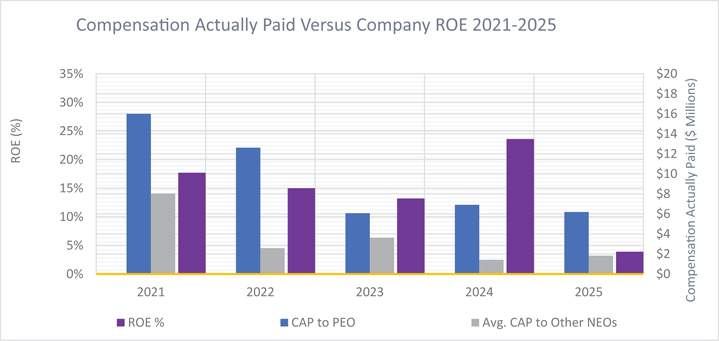
41
As demonstrated by the following graph, the amount of compensation actually paid to the relevant PEO for the applicable year and the average amount of compensation actually paid to the Company’s NEOs as a group (excluding the relevant PEO for the applicable year) is aligned with the Company’s TSR over the five years presented in the table.
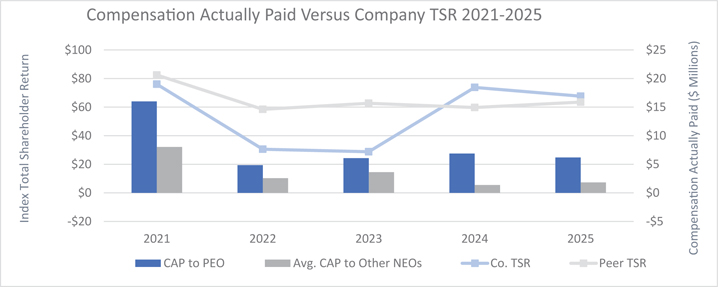
Compensation Actually Paid and Net Income
As demonstrated by the following table, the amount of compensation actually paid to the relevant PEO for the applicable year and the average amount of compensation actually paid to the Company’s NEOs as a group (excluding the relevant PEO for the applicable year) is generally aligned with the Company’s net income over the five years presented in the table.
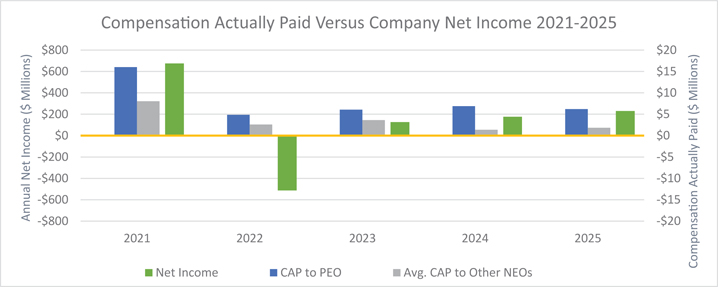
| EQUITY COMPENSATION PLAN INFORMATION |
On June 14, 2023, the Board recommended and shareholders approved the Chimera Investment Corporation 2023 Equity Incentive Plan (the “EIP”). We adopted the EIP to provide incentives to our independent directors, employees, and other service providers to stimulate their efforts toward our continued success, long-term growth, and profitability and to attract, reward and retain personnel.
42
On September 19, 2025, our compensation committee approved the Chimera Investment Corporation 2025 Inducement Award Plan (the “Inducement Award Plan”) in connection with our acquisition of HomeXpress.
The following table provides information as of December 31, 2025 concerning shares of our common stock authorized for issuance under our existing equity incentive plan. The total share numbers reflect a 1-for-3 reverse stock split that became effective following the close of business on May 21, 2024.
|
Plan Category |
Number
of Securities to be Issued Upon Exercise of Outstanding Options, Warrants, and Rights (1) |
Weighted
Average Exercise Price of Outstanding Options, Warrants, and Rights |
Number
of Securities Remaining Available for Future Issuance Under Equity Compensation Plans(2) |
| Equity Compensation Plans Approved by Stockholders | 2,360,452 | — | 4,023,572 |
| Equity Compensation Plans Not Approved by Stockholders (3) | 528,318 | — | 11,682 |
| Total | 2,888,770 | 4,035,254 |
| (1) | Includes unvested RSUs and PSUs and related dividends. |
| (2) | Available shares are reduced by the items outstanding in column 1 plus shares previously vested and issued net of units withheld to cover tax withholding requirements. |
| (3) | These awards were issued under the Company’s Inducement Award Plan, adopted by the Company in connection with its acquisition of HomeXpress. The plan reserves up to 540,000 shares of our common stock for the grant of inducement options, stock appreciation rights, restricted stock, dividend equivalent rights, and other share-based awards. On September 19, 2025, the compensation committee approved inducement grants representing a total of 533,391 RSUs, effective October 1, 2025, which were granted to approximately 300 individuals offered employment with the Company in connection with our acquisition of HomeXpress. In accordance with NYSE Rule 303A.08, the grants were made exclusively to individuals who were employed by HomeXpress as a material inducement to such individual’s continued service following Chimera’s acquisition of HomeXpress, which closed on October 1, 2025. |
| COMPENSATION COMMITTEE INTERLOCKS AND INSIDER PARTICIPATION |
Our compensation committee is comprised solely of the following independent directors: Mr. Creagh (chair), Mr. Chavers and Ms. Still. None of these directors is serving or has served as an officer or employee of us or any affiliate or has any other business relationship or affiliation with us, except his or her service as a director. No member of the compensation committee has had any relationship with us requiring disclosure under Item 404 of Regulation S-K. During 2025, none of our executive officers served on the compensation committee (or other committee serving an equivalent function) of another entity whose executive officers served on the compensation committee or Board.
|
COMPENSATION OF DIRECTORS |
Overview and Process
We compensate only those directors who are independent under the NYSE listing standards. Any member of our Board of Directors who is an employee of ours is not considered independent under the NYSE listing standards and did not (and will not) receive additional compensation for serving on our Board of Directors.
Our compensation committee, together with FW Cook, a nationally recognized compensation consulting firm retained by our Board of Directors, reviews the components of the compensation arrangements offered to our independent directors. As part of this process, our compensation committee considers, among other things, the duties and responsibilities associated with the position of each director and emerging trends and best practices in director compensation.
The compensation committee will, on an ongoing basis, continue to examine and assess our director compensation practices relative to our compensation philosophy and objectives, as well as competitive market practices and total stockholder returns, and will make modifications to the compensation programs, as deemed appropriate. The compensation committee also considers the compensation of boards of directors of the same group of peer companies that the committee considers for the compensation of our named executive officers.
43
Amount and Form of Director Compensation
Based upon the recommendations of FW Cook, among other things, and our compensation committee’s review of FW Cook’s analysis, our compensation committee recommended to our Board of Directors, and our Board of Directors approved, the following annual compensation arrangements offered to our independent directors for the 2025-2026 director service year beginning June 1, 2025 for directors serving on the Board at the conclusion of the 2025 annual meeting of stockholders, which have not changed from the 2024-2025 director service year:
|
Annual cash retainer (paid quarterly) |
$100,000 |
| Annual stock award amount (RSUs with 1-year vesting) | $130,000 |
| Annual cash fee for Board Chairperson | $120,000 |
| Annual cash fee for Audit Committee Chairperson | $50,000 |
| Annual cash fee for Compensation Committee Chairperson and Risk Chairperson | $25,000 |
| Annual cash fee for Nominating and Corporate Governance Committee Chairperson | $25,000 |
| Annual cash fee for Committee Membership (other than Committee Chair) | $10,000 |
Directors receive a grant of RSUs equal in value to the annual stock award amount on the date of the annual meeting of stockholders for that year. The RSUs accrue dividend equivalent rights and vest on the earlier of (i) the one-year anniversary of the grant date and (ii) the following year’s annual meeting date, unless the director’s service terminates prior to such date in which case the RSUs vest pro rata on such date based on the number of days the director served as director during the director service year.
Previously, we established a Stock Award Deferral Program, comprised of the Executive Officer Plan and the Director Plan, as described above under “Nonqualified Deferred Compensation.” Under this program, our directors could elect to defer payment of stock awards until termination of their directorship or an earlier specified date. Amounts deferred are tracked as DSUs, continue to receive dividend equivalents, and are paid in actual shares. The compensation committee felt that this program encourages directors’ long-term retention of stock awards earned under our director compensation program. On November 5, 2024, the compensation committee took action to suspend new deferral elections under the Director Plan. All deferrals previously made under the Director Plan will remain outstanding, and all deferrals pursuant to prior elections made by directors will be paid on the originally scheduled payment dates.
Expense Reimbursement
We also reimburse our directors for their travel expenses incurred in connection with their attendance at Board of Directors and committee meetings.
2025 Director Compensation
The table below summarizes the compensation paid by us to our independent directors for the year ended December 31, 2025.
|
Name |
Fees
Earned or Paid in Cash ($) |
Stock Awards ($)(1)(2) | Total($) |
| Gerard Creagh | $265,000 | $134,718 | $399,718 |
| Brian P. Reilly | $160,000 | $134,718 | $294,718 |
| Debra W. Still | $135,000 | $134,718 | $269,718 |
| Kevin G. Chavers | $127,500 | $134,718 | $262,218 |
| Susan Mills | $120,000 | $134,718 | $254,718 |
| Cynthia B. Walsh | $69,166 | $134,718 | $203,884 |
| Sandra Bell(3) | $48,214 | - | $48,214 |
| (1) | Stock Awards includes an RSU Award on June 10, 2025, for the director service year ending on the date of the Annual Meeting. |
| (2) | For amounts under the column “Stock Awards,” we disclose the grant date fair value for the RSU award measured in dollars based on the closing price of our common stock on the applicable grant date (or next preceding trading day if the grant date was not a trading day) but excluding the effect of potential forfeitures, calculated in accordance with FASB ASC Topic 718 – Compensation – Stock Compensation. |
44
| See Note 15 to our Consolidated Financial Statements included in our Annual Report on Form 10-K filed for the year ended December 31, 2025, for additional information on the assumptions used in the grant date fair value for our equity compensation awards. The aggregate number of unvested stock awards outstanding as of December 31, 2025 for each director was 9,685. |
| (3) | Ms. Bell resigned from the Board effective April 9, 2025. |
| CERTAIN RELATIONSHIPS AND RELATED TRANSACTIONS |
Related Party Transactions Policy and Procedures Regarding Transactions with Related Persons
We have in place a Related Party Transactions Policy, which was adopted to further the goal of ensuring that any related person transaction is properly reviewed, approved or ratified, if appropriate, and fully disclosed in accordance with applicable rules and regulations.
The policies and procedures apply to transactions, arrangements and relationships between the Company and any related party, which includes executive officers, directors, director nominees, greater than 5% common stockholders and the immediate family members of each of these groups, as well as an entity in which any of the foregoing individuals is employed or an entity which is controlled by any of the foregoing individuals.
For purposes of the policies and procedures, a related person transaction is a transaction, arrangement or relationship, or any series of similar transactions, arrangements or relationships, in which (i) the aggregate amount involved will or may be expected to exceed $120,000, (ii) the Company is a participant, and (iii) any related person has or will have a direct or indirect material interest.
Under the policies and procedures, the related party, or any director, officer or employee of the Company who knows of the transaction must notify and provide information regarding the transaction to the Chief Legal Officer or other officer designated in the policy and the Chairman of the Board. Following an evaluation, if the transaction does in fact constitute a related party transaction for which disclosure would be required under Item 404 of Regulation S-K, the Audit Committee will consider such transaction, after reviewing relevant facts and circumstances, and determine whether to approve or ratify such transaction, or determine to bring the matter to the full Board. The Audit Committee may impose such conditions as it deems appropriate and may establish guidelines for future review of any ongoing related party transactions.
If the transaction involves a director, that director will not participate in the action regarding whether to approve the transaction.
Our Related Party Transactions Policy is intended to work together with our other policies, including our Code of Business Conduct and Ethics, which requires all of our personnel to be scrupulous in avoiding a conflict of interest regarding our interests. The Code of Business Conduct and Ethics prohibits us from entering a business relationship with an immediate family member or with a company in which the employee or immediate family member has a substantial financial interest unless such relationship is disclosed to and approved in advance by our Board of Directors. See “Corporate Governance, Director Independence, Board Meetings and Committee” for additional information on the Code of Business Conduct and Ethics.
Approval of Related Person Transactions
On December 2, 2024 (the “Closing Date”), the Company completed its acquisition of Palisades from Palisades Holdings II, LLC (the “Seller”) for $30,000,000 (the “Consideration”), and Jack Macdowell commenced his employment with the Company as its Chief Investment Officer. Mr. Macdowell owns 100% of Palisades Holdings I, LLC, an entity which owns 70% of the Seller. Contingent upon achievement of certain revenue targets arising from designated contracts of Palisades’ third-party transaction asset and management business (the “Designated Contracts”), the Consideration may be increased by up to an additional $20,000,000 as part of a series of earn-out payments (the “Earnout Payments”). The Earnout Payments, if any, will be based on the revenue received by the Company from the Designated Contracts over five measurement periods beginning on the Closing Date and ending on December 31, 2029, subject to minimum revenue thresholds. Seller will be paid the maximum amount of the Earnout Payments, $20,000,000, over the five measurement periods if the total revenue received by the Company from the Designated Contracts during those periods is at least $100,000,000. At the Company’s election, up to 50% of any Earnout Payment may be satisfied by issuing shares of the Company’s common stock, calculated using the 30-day volume-weighted average price of the Company’s common stock as listed on the New York Stock Exchange on the business day immediately preceding the relevant payment date. The Earnout Payment and related arrangements were approved by our Audit Committee in accordance with our Related Party Transaction Policy and audit committee charter. For the period from the Closing Date through December 31, 2025, the Company paid the Seller $4 million as Earnout Payments.
Other than the aforementioned transaction, we did not have any transactions with a related person as described in Item 404 of Regulation S-K in 2025.
45
|
REPORT OF THE AUDIT COMMITTEE |
Since our inception, we have had an audit committee composed entirely of non-employee directors. The members of the audit committee meet the independence and experience requirements of the New York Stock Exchange (“NYSE”). The Board of Directors has determined that each of Mr. Reilly and Ms. Walsh is an audit committee financial expert, and each member of the audit committee is an independent director within the meaning of the applicable rules of the Securities and Exchange Commission (“SEC”) and the NYSE. In 2025, the audit committee met five times. The audit committee has adopted a written charter outlining the practices it follows. A full text of our audit committee charter is available for viewing on our website at www.chimerareit.com. Any changes in the charter or key practices will be reflected on our website.
In performing all of its functions, the audit committee acts only in an oversight capacity, and necessarily, in its oversight role, the audit committee relies on the work and assurances of our management, which has the primary responsibility for financial statements and reports, and of the independent registered public accounting firm, who, in its report, expresses an opinion on the conformity of our annual financial statements to generally accepted accounting principles and on the effectiveness of our internal control over financial reporting as of year-end.
The audit committee has reviewed and discussed our audited financial statements with management and with Ernst & Young LLP (“Ernst & Young”), our independent auditors for 2025.
The audit committee has discussed with Ernst & Young the matters required to be discussed by applicable requirements of the Public Company Accounting Oversight Board (“PCAOB”).
The audit committee has received the written disclosures and the letter from Ernst & Young required by applicable requirements of the PCAOB regarding Ernst & Young’s communications with the audit committee concerning independence and has discussed with Ernst & Young their independence.
In reliance on these reviews and discussions, and the report of the independent registered public accounting firm, the audit committee recommended to our Board of Directors, and our Board of Directors approved, that the audited financial statements be included in our Annual Report on Form 10-K for the year ended December 31, 2025, for filing with the SEC. The audit committee also recommends the selection of Ernst & Young to serve as independent public accountants for the fiscal year ending December 31, 2026.
The foregoing report has been furnished by current members of the audit committee:
Brian P. Reilly, Chair
Gerard Creagh
Cyndi Walsh
The Audit Committee report above does not constitute “soliciting material” and will not be deemed “filed” or incorporated by reference into any of our filings under the Securities Act of 1933 or the Securities Exchange Act of 1934 that might incorporate our SEC filings by reference, in whole or in part, notwithstanding anything to the contrary set forth in those filings.
|
PROPOSAL
2 |
Pursuant to Section 14A of the Exchange Act, we are seeking an advisory vote on executive compensation matters. We currently seek such an advisory vote on an annual basis. The stockholder vote will not be binding on us or the Board of Directors, and it will not be construed as overruling any decision by us or the Board of Directors or creating or implying any change to, or additional, duties for us or the Board of Directors.
While this vote is advisory and not binding on us, it will provide information to us and the compensation and nominating and corporate governance committees regarding stockholder sentiment about our executive compensation philosophy, policies and practices, which the compensation and nominating and corporate governance committee will be able to consider when determining the appropriateness of our executive compensation.
At our 2025 annual meeting of stockholders, a majority of the votes cast on the “say on pay” proposal voted in favor of our executive compensation. The compensation committee believes the results of the 2025 “say on pay” vote demonstrated that stockholders generally agreed with our compensation program and policies and the compensation of our named executive officers.
46
The Board of Directors recommends that stockholders vote in favor of the following resolution: “RESOLVED, that the compensation paid to the company’s named executive officers, as disclosed pursuant to Item 402 of Regulation S-K, including the Compensation Discussion and Analysis, compensation tables and narrative discussion, is hereby APPROVED.”
THE BOARD OF DIRECTORS RECOMMENDS A VOTE “FOR” THE APPROVAL OF THIS RESOLUTION.
|
PROPOSAL
3 |
Our audit committee has appointed Ernst & Young to serve as our independent registered public accounting firm for the fiscal year ending December 31, 2026, and stockholders are asked to ratify the selection at the Annual Meeting. We expect that representatives of Ernst & Young will be present at the Annual Meeting, will have the opportunity to make a statement if they desire to do so and will be available to respond to appropriate questions. If the appointment of Ernst & Young is not ratified, our audit committee will reconsider the appointment.
Relationship with Independent Registered Public Accounting Firm
Expenses are generally accrued when services are provided. The aggregate fees billed for 2025 and 2024 for each of the following categories of services are set forth below:
|
Service Category |
2025 | 2024 |
| Audit | $2,957,789 | $3,117,303 |
| Audit-Related | $430,000 | $549,000 |
| Tax | $749,870 | $630,290 |
| All Other | $0 | $0 |
| Total | $4,137,659 | $4,296,593 |
Audit Fees: Audit fees primarily relate to integrated audits of our annual consolidated financial statements and internal control over financial reporting under Sarbanes-Oxley Section 404, reviews of our quarterly consolidated financial statements, audits of our subsidiaries’ financial statements and comfort letters and consents related to SEC registration statements.
Audit-Related Fees: Audit-Related fees are primarily for assurance and related services that are traditionally performed by the independent registered public accounting firm and include due diligence and accounting consultations.
Tax Fees: Tax fees include tax compliance, tax planning, tax advisory and related tax services.
All Other Fees: No other fees were billed for the fiscal years ended December 31, 2025 and December 31, 2024, respectively.
The audit committee has also adopted policies and procedures for pre-approving all non-audit work performed by our independent registered public accounting firm. Specifically, the audit committee pre-approved the use of Ernst & Young for the following categories of non-audit services: merger and acquisition due diligence; tax services; internal control reviews; securitization and securities issuance deals, and reviews and procedures that we request Ernst & Young to undertake to provide assurance on matters not required by laws or regulations. In each case, the audit committee also set a specific annual limit on the amount of such services that we would obtain from Ernst & Young, required management to report the specific engagements to the audit committee on a quarterly basis and required management to obtain specific pre-approval from the audit committee for any engagement over five percent of the total amount of revenues estimated to be paid by us to Ernst & Young during the then current fiscal year. Our audit committee approved the hiring of Ernst & Young to provide all the services detailed above prior to Ernst & Young’s engagement. None of the services related to the audit-related fees described above was approved by the audit committee pursuant to a waiver of pre-approval provisions set forth in the applicable rules of the SEC.
THE BOARD OF DIRECTORS RECOMMENDS A VOTE “FOR” THE RATIFICATION OF THE APPOINTMENT OF ERNST & YOUNG LLP AS OUR INDEPENDENT REGISTERED PUBLIC ACCOUNTING FIRM FOR THE YEAR 2026.
47
|
ADDITIONAL MATTERS |
Access to Form 10-K
On written request, we will provide without charge to each record or beneficial holder of our common stock as of April 9, 2026, a copy of our annual report on Form 10-K for the year ended December 31, 2025, as filed with the SEC. You should address your request to Investor Relations, Chimera Investment Corporation, One Rockefeller Plaza, 32nd Floor, New York, New York 10020 or email your request to us at investor-relations@chimerareit.com.
We make available on our website, www.chimerareit.com, under “Filings & Reports—SEC Filings,” free of charge, our annual reports on Form 10-K, quarterly reports on Form 10-Q, current reports on Form 8-K and amendments to those reports as soon as reasonably practicable after we electronically file or furnish such materials to the SEC.
Stockholder Proposals
Any stockholder intending to present a proposal pursuant to Rule 14a-8 of the Exchange Act at our 2027 annual meeting of stockholders and have the proposal included in the proxy statement for such meeting must, in addition to complying with the applicable laws and regulations governing submissions of such proposals, submit the proposal in writing to us no later than December 24, 2026.
In addition, pursuant to our current bylaws, any stockholder business proposal for consideration at the 2027 annual meeting of stockholders submitted outside the processes of Rule 14a-8 of the Exchange Act, including any stockholder nominations for our Board of Directors, must be received by us not earlier than 150 days nor later than 5:00 p.m. Eastern Time 120 days prior to the first anniversary of the date of the proxy statement for the preceding year’s annual meeting (or between November 24, 2026 and 5:00 p.m. Eastern Time on December 24, 2026, based on the date of this year’s Proxy Statement of April 23, 2026).
In addition, to comply with the universal proxy rules, stockholders who intend to solicit proxies in support of director nominees other than our nominees for our annual meeting to be held in 2027 must also comply with the additional requirements of Rule 14a-19 under the Exchange Act, including, by no later than April 11, 2027, including providing a statement that such stockholder intends to solicit the holders of shares representing at least 67% of the voting power of the Company’s shares entitled to vote on the election of directors in support of director nominees other than the Company’s nominees. If our 2027 annual meeting is changed by more than 30 calendar days from the first anniversary of our 2026 annual meeting, stockholders must comply with the additional requirements of Rule 14a-19 under the Exchange Act no later than the later of 60 calendar days prior to the date of the 2027 annual meeting or the 10th calendar day following the day on which public announcement of the date of the 2027 annual meeting is first made.
Any such nomination or proposal should be sent to the Corporate Secretary, Chimera Investment Corporation, One Rockefeller Plaza, 32nd Floor, New York, New York 10020 and, to the extent applicable, must comply with the requirements of our current bylaws.
Other Matters
As of the date of this Proxy Statement, the Board of Directors does not know of any matter that will be presented for consideration at the annual meeting other than as described in this Proxy Statement.
48
APPENDIX I
ROE Calculation
For purposes of calculating the ROE, the Company’s net income is determined in accordance with GAAP, but excluding non-cash, non-operating expense items such as depreciation expense, amortization of goodwill and other non-cash, non-operating expense items as determined by the compensation committee in its sole discretion for the applicable performance period. If, for any portion of any performance period, (i) the Company does not use hedge accounting or (ii) its derivative hedging instruments or any portion thereof are otherwise deemed ineffective, which in either case, results in changes in the value of such hedging instruments being recorded in the Company’s GAAP income statement, then any gains or losses from such hedging instruments will also be excluded. The Company’s average equity under the employment agreements means the stockholders’ equity of the Company as determined in accordance with GAAP, but excluding accumulated other comprehensive income or loss (which, among other things, reflects unrealized gains or losses in the Company’s residential mortgage-backed securities portfolio), stockholders’ equity attributable to preferred stock and other items as determined by the compensation committee in its sole discretion for the applicable performance period. For purposes of calculating ROE, Company Average Equity will be determined based on the average of the Company’s stockholders’ equity calculated as described in the preceding sentence as of the last day of each quarter during the applicable performance period. Notwithstanding the foregoing, stockholders’ equity attributable to an issuance of common stock of the Company during the performance period shall be excluded from the calculation of “Company Average Equity” for a period of six months from such issuance.
49
This page intentionally left blank.

CHIMERA INVESTMENT CORPORATION
ATTN: SUBRAMANIAM VISWANATHAN
ONE ROCKEFELLER PLAZA, 32ND FLOOR
NEW YORK, NY 10020

VOTE
BY INTERNET
Before The Meeting - Go to www.proxyvote.com or
scan the QR Barcode above
Use the Internet to transmit your voting instructions and for electronic delivery of information up until 11:59 p.m. Eastern Time on June 9, 2026. Have your proxy card in hand when you access the web site and follow the instructions to obtain your records and to create an electronic voting instruction form.
During The Meeting - Go to www.virtualshareholdermeeting.com/CIM2026
You may attend the meeting via the Internet and vote during the meeting. Have the information that is printed in the box marked by the arrow available and follow the instructions.
VOTE
BY PHONE - 1-800-690-6903
Use any touch-tone telephone to transmit your voting instructions up until 11:59 p.m. Eastern Time
on June 9, 2026. Have your proxy card in hand when you call and then follow the instructions.
VOTE
BY MAIL
Mark, sign and date your proxy card and return it in the postage-paid envelope we have provided or return it to Vote
Processing, c/o Broadridge, 51 Mercedes Way, Edgewood, NY 11717.
| TO VOTE, MARK BLOCKS BELOW IN BLUE OR BLACK INK AS FOLLOWS: | |||
| V92449-P49052 | KEEP THIS PORTION FOR YOUR RECORDS | ||
| THIS PROXY CARD IS VALID ONLY WHEN SIGNED AND DATED. | DETACH AND RETURN THIS PORTION ONLY | ||
CHIMERA INVESTMENT CORPORATION
| The Board of Directors recommends you vote FOR all nominees and FOR proposals 2 and 3. |
| 1. | Election of Directors | |||||||
| Nominees: | For | Against | Abstain | |||||
| 1a. | Gerard Creagh | ☐ | ☐ | ☐ | ||||
| 1b. | Kevin G. Chavers | ☐ | ☐ | ☐ | ||||
| 1c. | Susan Mills | ☐ | ☐ | ☐ | ||||
| For | Against | Abstain | |||||||
| 2. |
The proposal to approve a non-binding advisory resolution on executive compensation. |
☐ | ☐ |
☐ | |||||
| 3. | Ratification of the appointment of Ernst & Young LLP as independent registered public accounting firm for the Company for the 2026 fiscal year. | ☐ | ☐ | ☐ | |||||
NOTE: The proxies are authorized to vote in their discretion upon any other matter that may properly come before the meeting or any adjournment(s) or postponement(s) thereof. The undersigned acknowledges receipt of the Notice of the Annual Meeting and the accompanying Proxy Statement, the terms of each of which are incorporated by reference into this Proxy Card.
Please sign exactly as your name(s) appear(s) hereon. When signing as attorney, executor, administrator, or other fiduciary, please give full title as such. Joint owners should each sign personally. All holders must sign. If a corporation or partnership, please sign in full corporate or partnership name by authorized officer.
|
Signature [PLEASE SIGN WITHIN BOX] |
Date |
|
Signature (Joint Owners) |
Date |
Important Notice Regarding the Availability of Proxy Materials for the Annual Meeting:
The Annual Report and Notice and Proxy Statement are available at www.proxyvote.com.
| V92450-P49052 |
CHIMERA
INVESTMENT CORPORATION
This proxy is solicited by the Board of Directors
Annual Meeting of Stockholders
June 10, 2026
Revoking all prior proxies, the undersigned acknowledges receipt of the Notice of Annual Meeting of Stockholders to be held on June 10, 2026 and the accompanying Proxy Statement, the terms of which are incorporated by reference, and hereby appoints Phillip J. Kardis II and Subramaniam Viswanathan, and each of them, as proxies, with full power of substitution, to appear on behalf of the undersigned and to vote all shares of Common Stock, par value $0.01 per share, of Chimera Investment Corporation (the “Company”), that the undersigned is entitled to vote at the Annual Meeting of Stockholders of the Company to be held via a live webcast at www.virtualshareholdermeeting.com/CIM2026 commencing at 10:00 a.m., New York Time, on Wednesday, June 10, 2026 and at any postponement or adjournment thereof, as fully and effectively as the undersigned could do if personally present and voting, hereby approving, ratifying and confirming all that said attorneys and agents or their substitutes may lawfully do in place of the undersigned as indicated on the reverse side.
This proxy, when properly executed, will be voted in the manner directed herein. If no such direction is made, this proxy will be voted "FOR” all director nominees, “FOR” proposals 2 and 3, and in accordance with the Board of Directors’ recommendations upon such other matters as may properly come before the Annual Meeting of Stockholders.
Continued and to be signed on reverse side